

It was former Conservative secretary of state of state for employment – now Lord – Norman Tebbit, who famously suggested his father had simply got on his bike and found work when unemployed.
Life may rarely be quite that simple in these austere times, but for some prisoners at HMP Rochester in Kent, working with bikes could well be the first building block towards finding fulfilling employment and a new life back in society after serving their sentences.
The idea started with FCC Environment, which processes the prison’s waste and also operates Rochester’s three household waste and recycling centres (HWRCs) under a seven year contract, signed in 2010, with Medway council.
Before FCC Environment stepped in, tens of thousands of pounds a year were being spent by the prison on sending all of its waste to landfill, but the waste management firm has developed a system which it says will help the prison to achieve zero waste to landfill by 2015, thereby saving the prison landfill tax costs.
Now, inmates help to sort the recyclable waste – including scrap metal, wood, cardboard, rubbles and bricks, green waste and fluorescent tubes – at a new recycling centre within the prison grounds. Sorted materials and any remaining residual waste are then sent to FCC Environment’s recycling and energy from waste facility at Allington in Kent.
[testimonial id = “139” align=”right”]
Reuse
Recognising the potential to expand this work with the prison, the company’s reuse development manager, Steve Bell, and reuse project manager, Denise Austen, both began working on a reuse scheme, which sees inmates refurbish old bikes for resale by local charity Abacus – part of the West Kent Housing Association’s social enterprise strand.
Through the resulting scheme – dubbed ‘Re-love a bike’ – 500 old bicycles have been salvaged by HMP Rochester inmates since it began in June 2014, with nearly 100 of these so far sold on by Abacus –which recycles unwanted, pre-used furniture and household items and sells them on at a lower price to people in need – either at its local shops or online.
“We are trying to recover and reuse absolutely everything,” says FCC’s Mr Bell. “Any bike parts not suitable for reuse can be recycled because we also deal with the prison’s waste – it is a closed loop.”
Under the scheme, Abacus collects unwanted bikes from FCC Environment’s Capstone, Cuxton and Gillingham HWRCs.
As staff at FFC Environment’s site manager at the Cuxton HWRC note, there is no shortage of reusable yet unwanted items taken for disposal by local residents, and many of the bikes are those that children have grown out of. Often, members of the public approach staff if they feel an item they no longer want can be reused and sold for charity. But, if not, staff keep an eye out to make sure reusable items are placed into the reuse container rather than another one of the waste containers – items in good condition put into one of the waste containers cannot then be salvaged for reuse due to waste regulations.
“If you can reuse it you are getting more life out of it,” says FCC Environment chief executive Paul Taylor on visiting the Cuxton site. “If you turn it into something that can be reused again, then that is perfect.”
Bikes
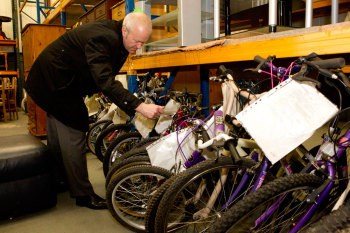
Suitable bikes donated at the HWRCs are then transported by Abacus to HMP Rochester for refurbishment by prisoners or stripped for parts. Up to ten prisoners work with a trained officer in a purpose-built workshop to restore the bikes, which are safety checked and then sold at Abacus’ three shops in Medway, Maidstone and Sevenoaks.
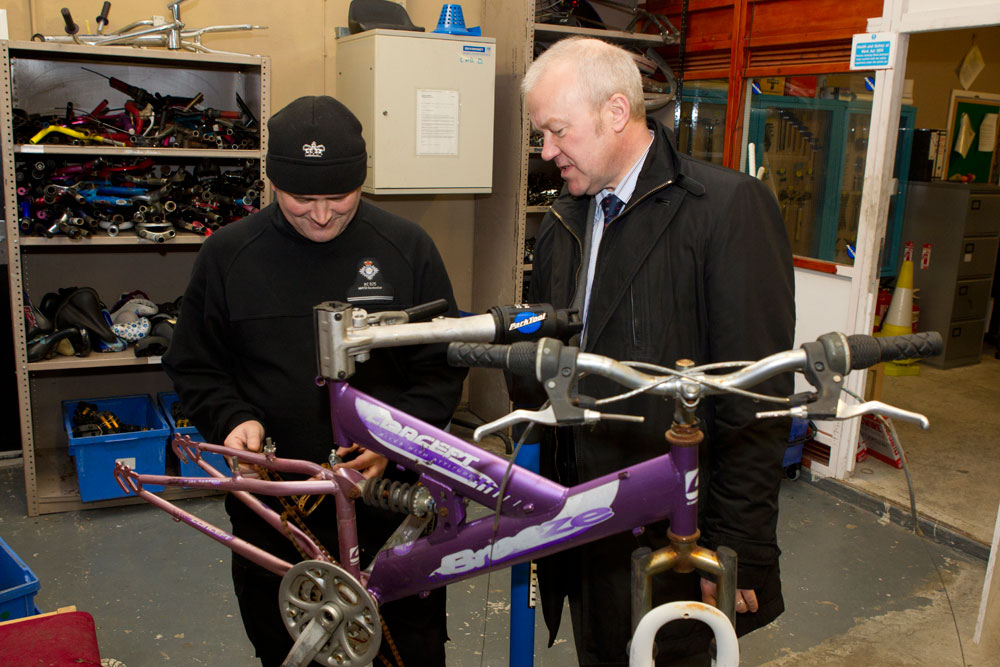
And, as well as restoring the bikes, prisoners who qualify for day release are able to work at Abacus Furniture Project stores, helping to sell the bikes and gaining valuable work experience.
According to HMPS prison officer Darren Conroy “you can hear a pin drop” when the inmates are at work on the bikes, which they generally do for around four hours in the morning, and another four in the afternoon, in an attempt to mimic as closely as possible a normal business working day.
Certainly, it is clear when speaking to the prisoners at the new bike workshop that they greatly value the opportunity to do something practical and engaging. And, given the work involved, it is also perhaps no coincidence that two of the inmates letsrecycle.com speaks to are a carpenter and a mechanic.
“The days go really quickly in here”, one says, who has been surprised by the quantity and quality of unwanted bikes coming into the workshop. “It’s amazing what comes in here really – it goes to show what a throwaway society we live in.”
Workshop
Inside the workshop, different bike parts are separated into boxes (50% of the donated bikes are stripped for parts) at one end, while prisoners each work on individual bikes around the sides of the room. Then, at the other end, safety-checked, refurbished bikes are labelled as ready for sale.
“If you’re mechanically minded it’s great,” one of the other inmate says, but adds: “There’s no point being here if you just want to skive – the bikes come back if they aren’t done properly.”
But with the extra difficulty of approving the likes of spray paint for use by prisoners at the workshop, although bikes are refurbished to working order, they aren’t given much aesthetic treatment. “It’s a pity we can’t paint them and spruce them up to make them look nicer,” the inmate laments of one of the children’s bikes he’s worked on.
Still, as Mr Conroy notes, “good news travels”, and although only running for six months, there is already a waiting list of prisoners wanting to work on the scheme.
“The bicycle repair workshop gives offenders so much more than time out of their cell,” says Mr Conroy, who adds that the “popular and highly attended” workshop will soon offer prisoners a City & Guilds qualification in bicycle maintenance. “They say refurbishing old, often rusty bikes gives them a sense of job satisfaction, especially as the bikes are sold through a charity.”
Partnership
With HM Prison Service, FCC Environment and Abacus working together, the scheme demonstrates a positive example of how beneficial such public-private-charity partnerships can be for all involved.
For FCC, the scheme may not generate much revenue, but it also doesn’t lose money. Meanwhile, prisoners gain important rehabilitative experience and charities are able to help underprivileged residents in the area at a lower cost.
HMP Rochester’s waste manager, Nathan De-Thabrew, said: “FCC Environment has not only enabled us to overhaul our waste management system, but is helping prisoners to gain new skills through the bike restoration programme. This is absolutely key to helping them find a job on release, which we know is one of the biggest factors in preventing people from reoffending.”
Meanwhile, for FCC Environment chief Paul Taylor, who also visited prisoners in the bike workshop, the scheme is also about showing the firm is capable of coming up with dynamic ideas to move waste up the hierarchy and – with hard work – making these ideas work in practice.
“The bike reuse scheme is a great project,” says Mr Taylor. “It saves bikes from landfill, enables prisoners to develop skills which will help them gain employment when they leave prison and local people can buy bikes at good prices which in turn benefits Abacus. I really enjoyed seeing how the project works and would like to thank everyone involved for making the bike reuse scheme such a success.”

Register for free to comment