


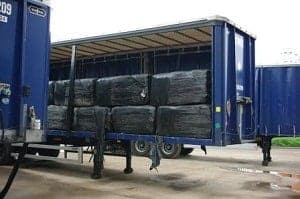
Exporting refuse-derived fuel to be burnt overseas is a retrograde step which could put billions of pounds of potential investment in new energy-from-waste infrastructure in the UK at risk.
That is the warning from Mike Hellings, managing director of Viridor, who told letsrecycle.com that any moves to send material to mainland Europe should be seen as a short-term recovery fix, and not a long term solution to diverting waste from landfill.
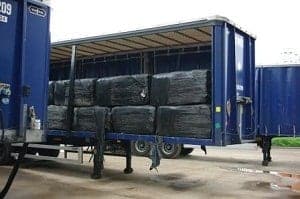
Mr Hellings comments came after letsrecycle.com last week revealed a continued increase in both the amount of material permitted for export, and in the number of companies approved to do so by the Environment Agency (see letsrecycle.com story).
Between September 2010 and September 2011, over one million tonnes of material was approved for export, with 14 companies permitted to send RDF overseas. Just 10 months ago, only three companies had permits in place (see letsrecycle.com story).
Commenting on the issue, Mr Hellings claimed that exporting greater volumes of RDF would discourage the considerable investment plans that both Viridor and other waste and recycling companies had put in place to increase the UKs recovery capacity.
He also highlighted the important role that biomass including using waste to generate energy had to play in meeting the UKs renewable energy goals. And, he said UK waste strategies had identified a clear role for EfW to also help meet waste treatment and diversion goals.
As such he said: While the legal position is complex, the export of RDF is a retrograde step which reflects poorly on the ability of the UK and some authorities and waste producers to effectively manage their own waste arisings within proximity of their source.
According to Mr Hellings, it is a nonsense from a resource management and efficiency perspective that UK companies are paying overseas countries to burn UK fuel and generate renewable electricity. This is particularly the case given the UKs importing of fossil fuels and electricity, he said.

Mr Hellings said that, by allowing the export of RDF to continue, several billions of pounds of potential green investment and thousands of associated skilled jobs are being put at risk. If our sector is to encourage further investment and job creation in the renewable energy sector in the UK, the granting one year export permits for RDF should only be seen as a short-term recovery fix.
ESA
Matthew Farrow, director of policy at the Environmental Services Association, echoed Mr Hellings concerns over exporting waste fuel in the long term in light of the UKs role as a net energy importer.
But, he said that, in light of difficulties faced in securing planning approval for new EfW plants, the situation was inevitable. The slowness of the UK planning system means that, at the moment, we have an under-capacity in EfW in the UK, while parts of the continent have spare capacity, so some export of RDF is a logical consequence, he told letsrecycle.com.
The aim must be to improve the planning system to enable ESA members to increase UK EfW capacity and so boost Britains energy security.
Similar concerns over the need to achieve energy security were aired by Gaynor Hartnell, chief executive of the Renewable Energy Association, who also said exporting waste fuel was contrary to the proximity principle.
Ms Hartnell did, however, claim that recent developments making it easier for EfW plants burning waste as fuel to claim the ROCs renewable energy subsidy could go some way to helping plants which could burn the material domestically to come on line. In July 2011, energy regulator Ofgem approved the Carbon 14 approach to measuring the renewable content of waste (see letsrecycle.com story).
Treasury
The export of the waste fuel means it is not landfill in the UK and as such the Treasury is losing substantial amounts of landfill tax. It also means landfill gas is not generated from the material.
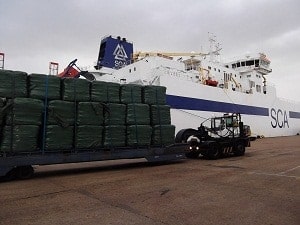
A spokesman for the Treasury told letsrecycle.com that, while it could lose out on revenue, the fact that the material was being diverted from landfill was the most important issue.
Turning municipal solid waste into fuel instead of landfilling it moves materials up the waste hierarchy, as intended by the landfill tax. While there are revenue implications resulting from the diversion of materials from landfill, the Government sees this as a successful application of landfill tax, he said.
He added: There is no evidence of rising landfill tax rates resulting in waste being sent overseas. Export of waste from the UK for disposal (e.g. landfill) is generally prohibited by the UK Plan for Shipments of Waste. Waste may be exported for recovery (e.g. recycling) and this is good for the global environment and reducing our reliance on natural resources.
New Earth
Among the companies to have sent RDF overseas in the past 12 months is New Earth Solutions, which sent just over 8,000 tonnes of material to the Netherlands. A spokeswoman for the company said the Dutch plant achieves high levels of energy efficiency, producing renewable energy and heat for a district heating scheme.
She noted the higher levels of demand for RDF overseas than in the UK, but stressed that the company only saw the export approach as a short-term option.
The demand for these types of fuel in mainland Europe is indeed greater than in the UK currently, due to overcapacity in the facilities over there. This is providing an opportunity for New Earth to divert more of its waste away from landfill. We export the RDF using returning, empty vehicles to minimise transportation impact, she told letsrecycle.com.
Ultimately, of course, it is our intention to use our
RDF in our own renewable energy facilities in this country, such as the 1 MW Advanced Thermal unit undergoing trials at our Dorset facility. Were also about to start the infrastructure works for a 7.5MW facility at New Earths recently opened 200,000 tonnes per annum MBT facility in Avonmouth.
She added: The export option provides New Earth with an interim position until we have established commercial energy recovery plants sited within our own waste treatment facilities or stand-alone.


Register for free to comment