

On 30 July, the council’s audit, standards and statutory accounts committee provided a report to the council on the “accuracy of invoices to EMR”.
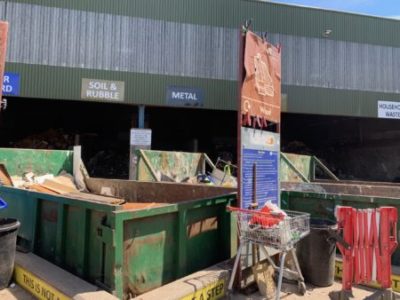
It noted that EMR collects metal from the council’s Townmead Road recycling centre several times a month, and at the end of each month sends an invoice detailing the price to be paid per tonne together with an overall amount payable.
However, the report says this is based on the weight recorded at EMR’s own facilities, rather than the council’s weighbridge.
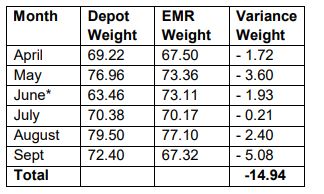
“Audit analysis between the depot and EMR monthly recordings of net weight of scrap metal collected between 1 April 19 to 30 September 19 resulted in the following weight variances all in favour of EMR,” the report said (table below).
Errors
And, the report also reveals that Richmond borough appears to have made errors in its record-keeping. The report stated that on 28 June 19, two collections of ferrous metal were collected by EMR from the depot. These collections were recorded on the Monthly Statement of Account issued by EMR. “However, concerningly for a reason unknown the collections were not recorded on the depots Weighbridge system,” the report said.
Resolution
The senior site supervisor at Richmond informed the committee that the weighing issue had been identified prior to the commencement of the audit, and taken up with EMR “without satisfactory resolution”.
“As a result, the depot over a period of time have held back on releasing the more precious scrap metals,” the report said.
The report added that the council will meet with EMR and draw up a list of “associated recommendations on improvements to the process”.
Meeting
A spokesperson for EMR, which has operations across the world, said: “As a leading metal recycler, we have facilities across the UK working with a wide range of customers including many local authorities. We are proud to work with Richmond Council on recycling their metal waste.
“We have robust processes that enable us to be transparent with all of our customers”
“We have robust processes that enable us to be transparent with all of our customers. All of our weighbridges are certified and are often used as public weighbridges as well.
“We take concerns of this nature very seriously and have investigated the issue internally. We are in the process of arranging a meeting with Richmond Council to resolve this matter.”
Recommendations
The report stated that the arrangement between EMR and Richmond is not part of a formal contractual arrangement in place with the contractor.
It therefore recommended the head of waste and street cleansing should “engage with the procurement function to draw up a contract for the sale of scrap metal as a matter of priority”.
“A decision also needs to be made as to whether to continue with the services of EMR or switch to another contractor,” the report added.
As part of the ‘management response’ section of the report, it said: “In consultation with procurement, the contract for the sale of scrap metal (currently via EMR) will be tested in the market and recommendations for new contract arrangements to be presented to Procurement Board. This contract to stipulate that net weight of materials will be based on the council’s weighbridge calculations”
Contamination
Contamination of metal recycling at recycling centres is an issue at some sites with regards to weight. Scrap from recycling centres or civic amenity sites is seen as having relatively high amounts of non-metallic items compared to the general ‘light iron’ grade for scrap. Examples include, if a resident places items such as furniture or mattresses in a metal container presumably assuming there is metal content in the form of springs, and it is missed by staff, recyclers would argue they shouldn’t have to pay the weight.
Industry issue
The metals sector trade association, the British Metals Recycling Association, issued a general statement on the topic of civic amenity site scrap in light of the Richmond matter.
The association said: “While BMRA cannot comment on the specifics of this case, however contamination within the scrap metal skips at a household waste and recycling site has long been an issue for our industry. Many people think they are doing the right thing by putting an item comprising of little metal – such as a wooden shelf with small metal brackets – in the scrap metal skip.
“However, this results in the scrap metal skip containing materials such as wood or plastic, which are less valuable or even hazardous and could, in fact, result in additional costs to the operator to process. One example is a child’s electric scooter, which contains a lithium ion battery. Unfortunately, this is likely to continue to occur unless there is a sustained effort to educate the general public on how to segregate waste appropriately.”
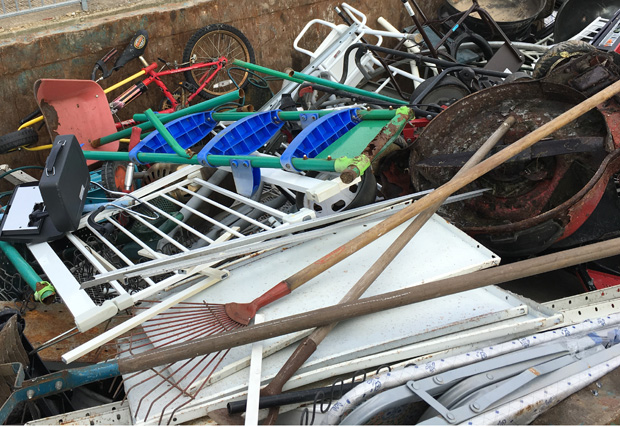
(Below: picture of CA site metal scrap at a London borough, not Richmond)


I will be very surprised if Richmond Council get their way with their weighbridge weight applying as this could be open to fraud. I look after high value metal for a client that weighs their material before it leaves site but it is the metal dealer’s weight that applies as there can be water ingress (snow & ice) and contamination that needs to be taken into consideration. According to the figures that I used during April – September 2019 the discrepacy amounts to ~ £1,175 if it was all ferrous scrap? To resolve this the contractor could provide evidence of any contamination present. plus there is usually a tolerence of +/- 50Kg between different weighbridges that needs to be taken into consideration.