


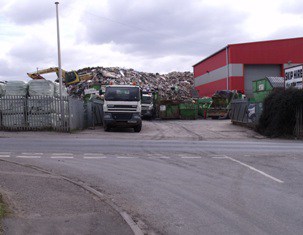
The company, Refuse Derived Fuel Ltd, and its directors Robert McNaughton and Sharon McCann were found in contempt of court at a Birmingham High Court hearing in June 2013 for failing to meet several deadlines they had previously committed to for reducing the height of RDF piles and also clearing some of the waste bales.
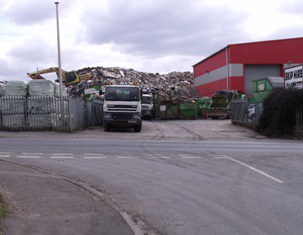
At this hearing, the Judge ordered that from July 10 2013 no further waste could be taken onto the Brierley Hill site on Moor Street and that by September 10 2013 the whole site must be cleared of RDF.
All three defendants were ordered to pay the EAs legal costs. Mr McNaughton was also sentenced to six months in prison, suspended until December 23 2013, when the prison sentence would be activated if the site was not cleared completely of RDF by 4pm on September 10.
However, the Environment Agency (EA) said it appeared that the company had failed to remove the RDF by the deadline after officers visited the Brierley Hill site last week.
Mr McNaughton may now face a prison sentence as the Agency said it intends to take the case back before court with evidence of the companys failure to meet the September 10 compliance date.
An Agency spokeswoman said: We have always believed that the most important thing is to get the site cleared and we are currently assessing the evidence of failure to comply with a view to taking the case back before the court.
We are also arranging to discuss the matter of waste removal with the landowners in consultation with the local councillors, Dudley Council and West Midlands Fire Service.
‘We have always believed that the most important thing is to get the site cleared and we are currently assessing the evidence of failure to comply with a view to taking the case back before the court’
Environment Agency spokeswoman
Refuse Derived Fuel Ltd could not be reached for comment when contacted by letsrecycle.com.
Legal action
Refuse Derived Fuel Ltd took over operation of the Moor Street site as well as its environmental permit and conditions from Brian Hill Waste in 2009.
But, according to the Agency, the companys activities on the site primarily processing collected waste into fuel (RDF) for burning elsewhere did not comply with the conditions of the permit transferred by Brian Hill Waste.
As a result, the EA undertook enforcement action against the company for storing waste above the permits maximum height requirements. An independent surveyors report in October 2012 found that the height of the RDF on site varied generally between around six metres and eight metres.
After enforcement action to secure the companys compliance with the sites permit proved unsuccessful, the Agency first took legal action against Refuse Derived Fuel Ltd and its directors in April 2012. A series of court cases subsequently taking place at the High Court in Birmingham.
Several hearings at the High Court in Birmingham subsequently followed in 2012 and 2013, at which the company and its directors made legally binding commitments to reduce the waste piles height and remove some of the waste bales.
Nearby residents had also raised concerns about the height of the stacked RDF bales on the Moor Street site and the Agency has written regularly to the community on the progress regarding removal of the waste.
RDF
Concern has been growing in the waste sector over the last year about the illegal storage and dumping of RDF, with waste also being found to have been illegally stored in the likes of Essex (see letsrecycle.com story) and Birmingham (see letsrecycle.com story).
Related Links
The concerns come alongside a rise in the number of waste operators seeking to produce RDF as an alternative to sending municipal waste to landfill.
RDF is produced by shredding and dehydrating solid waste and is burned to produce energy. The largest market for the material from the UK is northern Europe.
Although RDF is a fuel, it is still considered waste and it must be stored, transported and used in accordance with the relevant waste regulations.


Register for free to comment