

The Tech Metals Challenge, run by Germany’s Federal Agency for Disruptive Innovation (SPRIND), has backed a small cohort of technologies judged to have the potential to fundamentally reshape how critical and precious metals are recovered, refined and supplied at industrial scale.
As part of the programme, DEScycle will receive an initial award of €1.5 million, with the opportunity to secure up to €6 million in total funding over multiple stages, subject to technical and commercial progress.
Unlike conventional grant schemes, SPRIND’s funding model is focused on acceleration through scale-up and deployment milestones, rather than supporting incremental or early-stage research.
The multi-year initiative is designed to push selected technologies rapidly towards industrial application, addressing strategic supply chain challenges for critical raw materials.
Advancing metals recovery
As part of the challenge, DEScycle will collaborate with Seloxium in the UK, the University of Nottingham, and German technology company Esy Labs.
The consortium will work on advancing and validating new approaches to metals recovery that could reduce reliance on primary mining and improve circularity in high-value materials.
Rob Harris, CTO of DEScycle, said: “SPRIND backs technologies that are uncomfortable, ambitious, and capable of changing how entire industries operate.
“Their decision to support DEScycle is a strong validation that our approach to circular metals recovery can move beyond incremental gains and deliver a step-change in how critical metals are supplied at industrial scale.”
DEScycle’s work
Founded to address the growing challenge of electronic waste and critical metals supply, DEScycle’s technology is centred on the use of Deep Eutectic Solvents (DES).
These are recyclable liquid salts that can selectively dissolve metals from complex waste streams such as printed circuit boards and other electronic scrap.
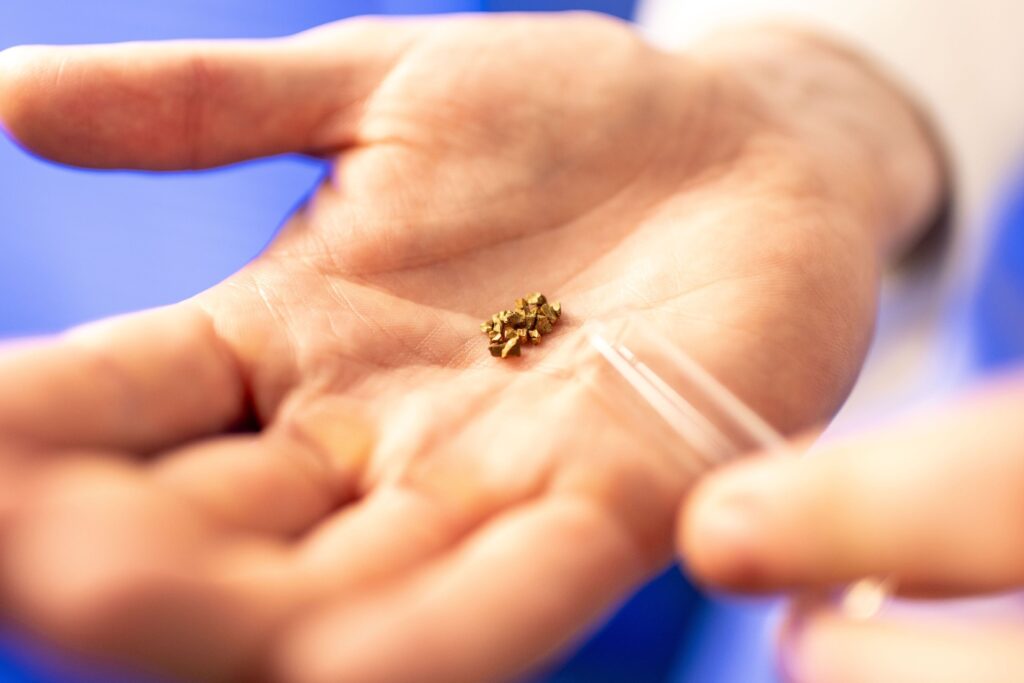
According to DEScycle, this enables over 99% recovery of metals – including gold, copper and rare earths – from printed circuit boards and other “e-scrap”.
Any solids left over, such as plastics, remain untouched and can be recycled onwards.
The company’s first demonstration facility is scheduled for commissioning in early 2026.
Fred White, COO of DEScycle, told Letsrecycle.com about the plant: “Our demo plant will be the first time we can get outside of the lab and demonstrate to the market that we can actually do what we say we can do, and what we have proven in the lab.”

Register for free to comment