


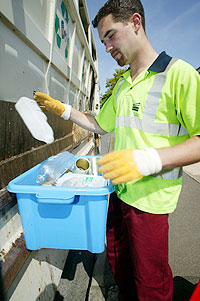
The events in London, Stoke-on-Trent, Bristol and Leeds in the last two weeks have offered advice on improving collections and resident participation.
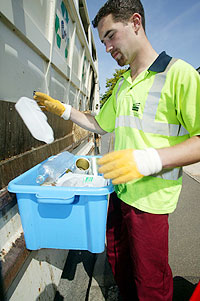 WRAP wants to see twice as many plastic bottles being collected from existing kerbside schemes |
Around 86% of councils in England offer some type of plastic recycling and 50% of households have kerbside collections for plastic bottles.
But Stuart Foster, project manager of plastic bottle recycling organisation Recoup, said: “Even if every local authority offered some form of plastic bottle recycling scheme, we would still need more. It's no longer enough to have a bottle scheme, you need to make it more efficient.”
Campaign
WRAP wants to double the average amount of plastic bottles collected from households from 5kg to 10kg, under its Target 10 campaign (see letsrecycle.com story).
The organisation has said four-fifths of plastic bottles are going to landfill and the new campaign urges councils to get the message out that all plastic bottles including “upstairs” bottles such as shampoo can be recycled.
A major television advertising campaign at national and regional level is provisionally booked for a summer launch. This will include advertisements similar to those already aired under the “Recycle Now” banner, which encourage glass recycling and feature Jane Horrocks.
The new spots will aim to get the message across using humorous gimmicks such as sun-tan bottles shouting “I want to get out of the protection racket”.
Literature for local authorities including leaflets and banners are expected to be available at the end of April.
Best Practice
Successful local authorities were used as examples of best practice at the conferences.
In Chesterfield, the borough council increased the capacity of waste bottles collected and transported in its vehicles by four times, through a leafleting campaign urging residents to “wash and squash” their bottles.
And in St Edmundsbury, council officers reduced the number of households putting contaminated material in their recycling bins from 1,500 to 95, through a sticker system.
A yellow sticker means the bin has been emptied, but carries a warning that the bin contained non-recyclable contaminants. A red sticker indicates that contamination was so severe the bin has not been emptied, and the householder could face a fine.
| Related links: |
Local authorities that have yet to introduce kerbside collections were asked to consider Bracknell Forest's example.
In 2002, the borough's kerbside recycling rates had dropped by 80%. It decided to introduce a plastic collection while launching a new campaign to revitalise the existing services and saw its recycling increase threefold.

Register for free to comment