

That was the view from Kronospan, one of the largest chipboard mills in the UK, which said last week that biomass plants should have incentives to use wood residues, panelboards like MDF and lower grade woods that cannot be recycled into chipboard.
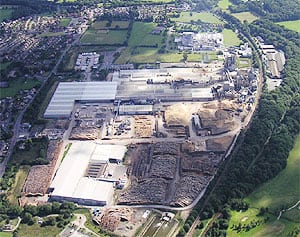 Kronospan's facility takes in around 350,000 tonnes of recycled chipped wood each year, but needs material with less than 5% contamination |
Speaking at the Recycling and Waste Forum in Birmingham, the company said the influx of biomass generation plants into the waste wood market could have a positive on chipboard firms if each focussed on separate wood waste streams.
Mr Coulson said with biomass firms taking wood like MDF, contamination levels for wood taken to chipboard mills could improve, allowing both sectors to expand.
He said: “Biomass is a potential threat, as it burns out material. But if it is managed correctly and targets dry boards, we believe that biomass can have a very positive impact on our industry.
“Burners should be incentivised to burn new material streams and residues. If this happens, I think we can work together to develop both our industries successfully and potentially millions of tonnes of wood could be diverted from landfill,” Mr Coulson said.
Kronospan alone takes in 350,000 tonnes of recycled woodchip a year at its plant in Chirk, near Wrexham, but can only tolerate up to 5% contamination levels for waste wood inputs. Mr Coulson said the UK demand for recycled woodchips was in the order of 10 million tonnes a year.
Biomass
Toby Beadle, commercial director at biomass firm Greenergy Bioenergy Ltd agreed at the conference that lower grade wood would be the most financially viable to use for power generation. He said higher grade wood should be used in added-value applications.
He explained that firms such as Greenergy, which has a 2 billion turnover, were becoming increasingly interested in biomass fuels like MDF and plywood, which were cheaper and dryer than traditional fuels like virgin wood.
He said: “We are looking at waste-based fuels and this is the next big step for us.”
WID
However, Mr Beadle, who in a previous role helped to source wood fuel for the Wilton 10 biomass plant on Teeside (see letsrecycle.com story), stressed that regulatory confusion over the position of lower grade waste wood in relation to the Waste Incineration Directive was acting as a barrier to the uptake of recycled material.
Under the regulations, using chemically-treated wood roughly quadruples the cost of building biomass boilers by putting emissions controls on the burning of waste, he explained.
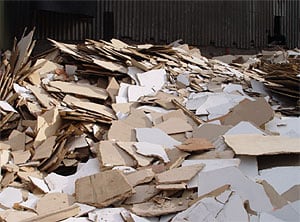 Biomass plants can take clean waste wood, but face difficulties with red tape concerning chemically treated woods |
Mr Beadle said it was too expensive and impractical to “prove” that the waste wood was safe to burn in a conventional boiler, and suggested that the authorities consider setting an accepted level of contamination for certain wood grades.
He said: “We have a burden of proof to the Environment Agency that wood is not treated but the cost of providing proof is prohibitive. We need to move to a legislative framework where we have a “deeming” approach, such as that used to say 65% of household refuse is biodegradable.”
“This will move forward the industry in leaps and bounds but it takes courage of the regulators to do it,” he added.
His concern came in the wake of the Environment Agency's decision to drop plans to redefine the point at which waste wood ceases to be waste under the BREW waste protocols project (see letsrecycle.com story).


Register for free to comment