

Yorwaste, which is a local authority company-owned by North Yorkshire County Council and City of York Council, has announced it is closing the operations of its Electrical Recycling Company at Hessay, near York. And in the south of England, W&S Recycling of Dorset are to withdraw from some civic amenity site collections.

York closure
The closure comes in the face of weaker commodity markets and a month after Yorwaste’s structure changed. On September 1 2015 it restructured to meet Teckal-exempt requirements with an aim of delivering “maximum value to our customers, shareholders and local tax-payers along with long-term stability to Yorwaste”.
The loss of the facility in York to process televisions means that collectors in the area will now have to find alternative outlets for processing and these are seen as being relatively limited.
A spokesman for Yorwaste said: “The decision has been made following a comprehensive restructuring of the Yorwaste Group and the resulting emphasis on its core activities of waste collection, transfer and processing, and the composting of green and wood waste.”
He added: “The Electrical Recycling Company was set up primarily to recycle CRT (Cathode Ray Tube) televisions, but in recent years volumes have dropped dramatically as flat-screen technology has evolved and become cheaper. At the same time, the value of commodities recovered from the process have been significantly impacted due to market conditions.”
Yorwaste has also reassured local residents that they “will still be able to dispose of their old televisions and smaller waste electrical equipment at their local household waste recycling centres”.
Concerns
Across the civic amenity sector there is growing concern about the reduced value of scrap metal and dealing with waste electrical and electronic equipment.
Already, waste management firm FCC has said it is holding meetings with local authorities and other waste management companies are understood to be in touch with councils where they run civic amenity sites or household waste recycling centres.
In the south of England, one CA site operator, W&S recycling told letsrecycle.com today (28 October) that the company was in the process of cutting out a number of WEEE collections because they were unviable.
Collection cuts
Commercial director Tony Knowles said: “We are having to cut our WEEE collections. We currently handle 32 HWRCs as main contractors and are considering pulling out of two big contracts.”
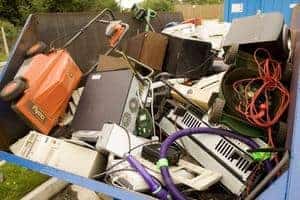
And, he said that local authorities should not be concerned about not having their WEEE collected. “Section 34 of the WEEE regulations means that local authorities can just phone up any producer compliance scheme and and the producer compliance schemes will pick up WEEE for free.”
Citing an example of increased costs, Mr Knowles said that in the past fridge plant operators would have given the company a rebate but now there was a considerable per tonne charge.
He emphasised: “Compliance scheme will have to go by the law and pick material up.”
Extreme
And, Mr Knowles referred to changes made to the WEEE system two years ago by the Department for Business (BIS) which aimed to end some perceived overcharging for WEEE evidence and to better align the need for evidence with the amount of evidence that a compliance scheme had access to.
Mr Knowles said: “Now the system has gone too far. Before changes were made two years ago there could have been some overcharging for WEEE but now it has gone from one extreme to the other.”
Last week, concerns about the current WEEE system were expressed by the operator of the SWEEEP authorised treatment facility in Kent (see letsrecycle.com story) which processes televisions. Managing director Justin Greenaway has also since noted that in his view “loss making at AATFs has funded the WEEE system money saving” in reference to reduced costs for producers under the new Department for Business system.
He added: “This is a fundamentally unsustainable situation for the AATF recycling industry.”

Register for free to comment