


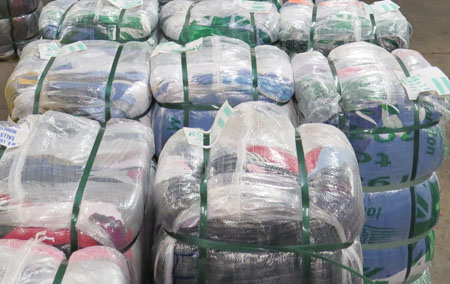
Josh Doherty reports from the Bureau of International Recycling’s world conference in Budapest.
The concerns were raised by a panel speaking in a round table discussion at the Bureau of International Recycling (BIR) 2019 convention in Budapest. High on the agenda were European Union plans for mandatory kerbside textile collections, which member states have to introduce by 2025 as part of the Circular Economy Package.

Comprised of representatives from France, Belgium, Italy, the Czech Republic and the UK, the panel all agreed that prices are suffering from increasing difficulties in sorting out quality material.
The discussion was kicked off by Paul T’Jollyn, of the Belgian recycling company Recutex NV.
Kerbside
Mr T’Jollyn said authorities in Belgium have already begun rolling out collections ahead of the European Directive, but it is having a negative impact.
“Our authorities already push people to put all kind of textiles in textiles containers. Even material which goes directly for incineration.
“This means that the quality of our material is going down, and we will have a larger quantity of material for incineration, which will put a big pressure on the margins of the sorting companies.”
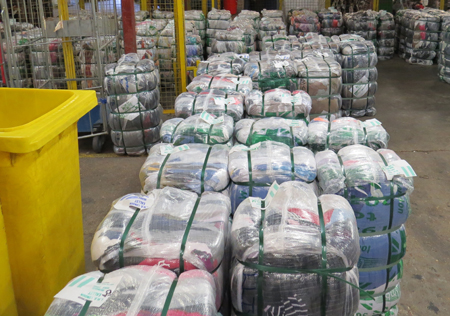
He also commented on market demand for material, saying that “there is still a fair demand from Africa and Eastern Europe, but merchants are obliged to reduce prices considerably”. This was put down to currency issues brought on by declining economies and reduced oil prices.
Brexit
Alan Wheeler, director of the UK’s Textile Recycling Association, used his time to discuss the potential impacts of a no-deal Brexit.
He stated that despite rising hopes of a deal, the vast majority of exports to Europe could be hit with tariffs, and the sector would also be impacted by a reduction in EU migrants coming to the UK to work in the textile industry.
“For us in the used textiles sector we potentially face the additional burden of import duties on our clothing products,” he stated.
Mr Wheeler added: “Also, nobody seems to have woken up to the government’s favoured proposal, which if enabled will prevent UK business from taking foreign workers for jobs less than £30,000 a year.
“Can you imagine paying textile sorters that much? It’s absurd. Without them arriving in significant numbers it will be difficult to maintain business in the UK.”
Kerbside collections
Other speakers on the BIR textiles panel also warned of the “ever-increasing low quality of materials” coming through and aired concerns over the impact that mandatory kerbside collections will have.
In the UK, some textile merchants have stopped collecting kerbside material due to its high levels of contamination(see letsrecycle.com story).This was due to the fact that clothes which are dirty or wet can’t be sold on for re-use, with the only market being for wipers, which has low profit margins.
“There is still a fair demand from Africa and Eastern Europe, but merchants are obliged to reduce prices considerably.”
The panel all also explained that there doesn’t seem to be any short-term easing of market pressures, and with a potential recession looming, it is expected to continue.
However, many said that efforts have ramped up to find a solution for the ‘upcycling’ of material, and while this represents a “light in the darkness,” according to the Italian representative, Suaro Ballerini of Bellerini Textiles, “there is still a long way to go”.

Register for free to comment