

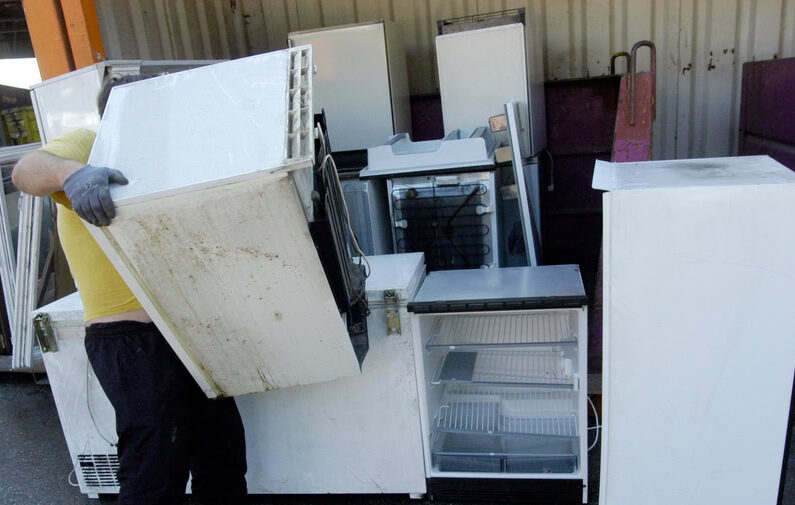
Carmarthenshire County Council is the latest authority to suspend collections of fridges, freezers and other cooling appliances after its recycling centres reached their safe storage capacity for “COLD” units.
In a statement issued this week (13 July 2026), the council said ongoing disruption at external treatment facilities had left it with no option but to stop accepting the items until further notice.
Carmarthenshire County Council’s Cabinet Member for Transport, Waste and Infrastructure Services, Councillor Edward Thomas, said: “Unfortunately, circumstances beyond our control have resulted in a temporary disruption to the collection and processing of refrigeration appliances.
“Our recycling centres have now reached their storage limits for these items, and we have had to suspend acceptance until further notice.”
It is far from an isolated case. Earlier this year, Norfolk temporarily stopped accepting fridges and freezers at its recycling centres, while South Gloucestershire warned it may have to suspend collections because of a national shortage in treatment capacity. Peterborough has also experienced disruption linked to collection and processing contractors.
The UK’s fridge recycling network
The reason these localised disruptions are attracting attention across the waste sector is that refrigeration appliances occupy a uniquely specialised part of the UK’s WEEE treatment network.
Unlike many other waste streams, refrigeration appliances cannot be easily diverted to another recycler when capacity becomes constrained.
Fridges and freezers contain refrigerant gases and insulating foams that must be removed under tightly controlled conditions to prevent emissions of ozone-depleting substances and greenhouse gases.
Processing therefore takes place at a relatively small number of highly specialised Approved Authorised Treatment Facilities (AATFs), equipped with automated depollution and shredding systems designed specifically for cooling appliances.
This concentration of infrastructure has made the sector vulnerable to disruption.
Where plastics, metals or paper can often be redirected between multiple facilities, the UK’s fridge recycling network relies on only a handful of operators with the necessary technology and environmental permits.
Why is fridge recycling capacity currently limited?
The pressure currently facing the sector is being caused by a series of operational and commercial disruptions that have unfolded over the past few years, reducing the capacity of the UK’s fridge recycling network.
A significant setback occurred in November 2025 when Unimetals Recycling filed a petition for compulsory liquidation after failing to secure new investment or complete a sale of the business.
The liquidation was particularly notable given the scale of the business. Unimetals had acquired Sims Metal Management’s UK operations for £195 million just a year earlier, creating one of the country’s largest independent metal recycling businesses, with around 650 employees across 27 sites.
Its Newport facility was one of only a handful of specialist fridge recycling plants in the UK, and the closure removed an estimated 600,000 units of annual refrigeration treatment capacity from the market.
The sector’s capacity was further tested in 2026 by a series of fires at specialist treatment facilities. In February, a fire forced the closure of EMR’s fridge recycling plant at Darlaston in the West Midlands.
Just two months later, Wiser Recycling’s treatment facility at Thetford was severely damaged by fire. The site processed a significant proportion of the electrical waste collected at Norfolk’s household waste recycling centres, including refrigeration appliances.
Following the incident, Norfolk County Council was forced to temporarily restrict the acceptance of several electrical waste streams while alternative arrangements were put in place.
Although collections were partially restored after the council provided additional storage capacity, Wiser Recycling subsequently lost its AATF status and ceased operating from the site, removing another outlet for specialist WEEE processing.
These incidents are not without precedent. In 2023, an explosion and fire at Shore Recycling’s WEEE processing facility in Perth resulted in the tragic death of a worker and serious injury to another, highlighting the wider operational risks associated with processing large volumes of waste electrical and electronic equipment.
The site was forced to close, until it was acquired and reopened by Enva in March 2025. The WEEE recycler is in the process of opening another fridge recycling facility in Dartford, Kent.
Industry considers exporting
For local authorities, the immediate problem is not necessarily collecting fridges, but storing them. HWRCs have finite storage areas and are subject to permit conditions governing how much hazardous and specialist waste can be held on site.
As treatment facilities have reduced throughput or temporarily closed, those storage compounds have gradually filled. Once they reach their permitted capacity, councils have little choice but to suspend acceptance until material can be removed.
With domestic capacity under sustained pressure, industry is understood to be exploring options for exporting refrigeration appliances for treatment overseas where suitable facilities exist.
Whether that becomes a temporary relief measure or a more significant feature of the market will depend on how quickly lost UK processing capacity can be restored.
In light of these problems, the Environment Agency and industry have set up a working group to look at options to ease the storage issues whilst EMR’s Darlaston facility comes back online, and Enva completes the construction of its new plant in Dartford.
The Environment Agency has also approved a new Regulatory Position Statement to allow business to apply to store fridges on unlicensed sites. Businesses wishing to seek permission should contact wastetreatment@environment-agency.gov.uk.

Yay. More refrigerators coming to a roadside hedgerow soon.
Where I live 95% of fridges left out have the compressors ripped out letting out the gas before they collected!
I can see the photo used for this article is a stock image, but wherever it was taken I hope they’ve since improved their approach to safe working – flip flops seriously!!!