


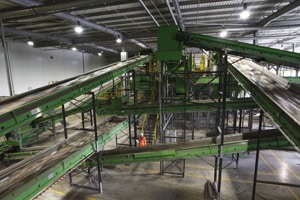
AmeyCespa has said it has resolved problems at its Waterbeach mechanical biological plant in Cambridgeshire following delays in the commissioning process which saw more than 26,000 extra tonnes of residual waste sent to landfill.
The waste management firm told letsrecycle.com that it has carried out improvement work to the MBT facility and is now processing all waste received at the site. The facility was due to be commissioned in November 2010 but fell behind schedule due to mechanical issues.
Commenting on the problems, a spokeswoman for AmeyCespa told letsrecycle.com: Installation of large and complex technology can be challenging. Some mechanical issues were experienced with the plant and have been dealt with as part of the commissioning process.
The comments came after a freedom of information request revealed that 26,574 tonnes of waste was sent to landfill instead of being treated at the MBT plant, meaning that Cambridgeshire county council incurred costs of 1,448,168 in additional landfill tax. However, AmeyCespa is compensating the council for the additional costs by charging a reduced gate fee 72% of the fee that would be normally charged.
Contract
The 200,000 tonne-a-year capacity Waterbeach MBT facility was built as part of a 28-year, 731 million PFI contract between AmeyCespa and Cambridgeshire county council for waste treatment and disposal (see letsrecycle.com story) . The contract was originally with Donarbon Waste Management but transferred to AmeyCespa following its acquisition of the company in September 2011 (see letsrecycle.com story).
Commenting on the improvement works, Sarah Clover, account director for AmeyCespa, said: We have implemented a number of improvement works to the MBT plant to ensure that it is delivering all the requirements of the contract. Since our improvements were completed, the plant has been processing all the waste delivered to it.
We have good long-term markets for many of the materials. All recovered metals and plastic bottles are sent for recycling. We continue to work closely with our partners Cambridgeshire County Council to ensure that the PFI contract provides best value to the authority and the flexibility required for the future.
The facility is expected to process 110,000 tonnes of residual waste this year. AmeyCespa said the plants extra capacity was to accommodate growth in Cambridgeshires waste arisings during the life time of the contract.
Delay
In an update on the waste PFI contract published on March 30 2012, following a meeting of Cambridgeshire councils enterprise, growth and community infrastructure overview and scrutiny committee, the reason for the delay in commissioning was attributed to plants construction contractor, BAM Nuttall.
“We have implemented a number of improvement works to the MBT plant to ensure that it is delivering all the requirements of the contract. Since our improvements were completed, the plant has been processing all the waste delivered to it.”
Sarah Clover, AmeyCespa
The update says: The principal reason for the delay can be attributed to the construction contractor (BAM Nuttall) working on behalf of AmeyCespa. In terminating the contract between the two companies AmeyCespa are endeavouring to remedy the failings in the plants design and machinery. The most time consuming has been the installation of additional acid scrubbing capacity to remove the excess ammonia from part of the composting hall instead of the air passing directly to the bio-filter.
A spokesman for BAM Nutall told letsrecycle.com: The contract element that was terminated is the long term maintenance of the plant and equipment. It has been commissioned and is up and running but there was a maintenance element to the contract. The spokesman declined to comment further.
The MBT plant uses mechanical separation to remove any dry recyclables from the residual waste stream, such as metals, plastics and film. The remaining material is then composted for seven weeks to produce a compost-like output (CLO).
The update explains that a suitable market for the CLO still needs to be found. It says that markets are being explored but until the plant is fully commissioned the consistency of the CLO cannot be guaranteed. The update says it may be appropriate to process it for burning as solid recovered fuel or export it to Europe. At present the CLO is sent to the on-site landfill.
Compensated
A spokesman from Cambridgeshire county council said: Cambridgeshire county council and AmeyCespa are absolutely committed to reducing the amount of waste we send to landfill. I can reassure residents, while the authority may have incurred additional landfill tax charges these have been compensated by savings we have made in our contract with AmeyCespa. Whilst the plant has not been fully commissioned, it has still been working and processing waste – more waste would have been sent to landfill had we not had the plant.
It should also be remembered we have one of the best recycling rates in the country and when the commissioning of the MBT plant is completed we will have a world class facility to meet our recycling needs for well into the future.
As of 2010/11 the countys recycling rate was 54% making it one of the highest performing county councils for recycling in the country.

Register for free to comment