
The facility, which was designed and constructed by Agrivert, was officially opened by Richard Thake, chairman of Hertfordshire county council.
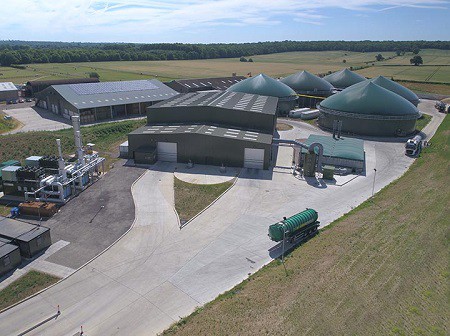
It was constructed in 11 months and is already operating at full power converting waste into renewable energy and nutrient rich biofertiliser, according to Agrivert. The footprint of the facility is 3.8 hectares.
Built to service Hertfordshire’s municipal food waste and local businesses, the plant also currently serves Essex county council under a short term contract. Located 18 miles from central London’s Marble Arch and the same distance from Park Royal – which Agrivert calls one of the UK’s largest food manufacturing hubs – the plant is also expected to attract some waste from the wider London area.
Energy
Agrivert service a total of 38 local authorities with organic waste recycling solutions. And, it claims to produce more energy from food waste than any other recycler in the UK.
According to Agrivert, the plant is set to process 50,000 tonnes of food and liquid wastes per year, generating 3MW of electricity each year and producing enough energy to power 5,900 homes. The facility will directly power the local homes and businesses from which the food waste originated, it is noted.
In addition to renewable power, the facility also produces bio-fertiliser (digestate), which Agrivert said can displace fossil fuel derived fertilisers on over 3,000 acres of local farm land.
The plant has recently achieved the British Standards Institute quality standard PAS110, which is hailed as a ‘key milestone’ by Agrivert, and, which demonstrates “the quality of Agrivert’s Digestate and certifying it as a high quality, fit for purpose product rather than a waste material.”
And, the company claims the net impact of CH4 removal, energy production and replacement of fossil fuel fertilisers means that the AD facility has the equivalent net green benefit of taking 86,000 cars off the road annually.
Contract
Agrivert holds a 15-year contract for the recycling of domestic food and garden waste collected in Hertfordshire. And, the company said it is working with the county to increase ‘source segregated food waste collections’ whilst ‘supporting’ districts that cannot yet achieve this by recycling comingled food and green waste at the existing in-vessel composting facility (IVC) located at South Mimms.
All food waste separately collected from householders within Hertfordshire district councils, namely Dacorum, Broxbourne, Three Rivers, and St. Albans, is recycled at this new AD facility.
Speaking at the opening ceremony, Agrivert chief executive Alexander Maddan, said: “We are proud of this AD project and the increased accessibility to our industry-leading food waste recycling services it brings.
“Local plants such as this reduce the cost of waste collection and treatment and should provide an incentive for many businesses to recycle food waste.
‘Delighted’
“We are delighted to be working with Hertfordshire, Essex and London councils, who have been supportive partners at every step. Indeed we could not have delivered this facility so quickly if we had not had such progressive relationships.”
Richard Thake, chairman of Hertfordshire county council, added: “I welcome Agrivert’s investment in Hertfordshire and I’m very pleased to have officially opened the new Anaerobic Digestion plant at London Colney. This facility will bring a number of benefits to the county.
“By sorting food waste from general household rubbish we can prevent, large amount of waste being sent to landfill, where it would generate greenhouse gas emissions.”
The digestion retention period lasts for 75 days. Biogas created during this process is converted to renewable electricity and fed to the national gird. Excess heat produced is used to warm the digesters and to heat the pasteurisation process.
With the addition of the new facility, Agrivert currently operates five AD plants across the south of the UK. The company also has two IVC facilities and two composting sites.

Register for free to comment