


Peter Simoes of AEB Amsterdam said there was a capacity of around seven million tonnes in the Netherlands, with less than six million tonnes available in the domestic Dutch market.

Mr Simoes told letsrecycle.com that the amount of residual waste available from the Netherlands was also falling as more green waste went to digestion plants and more plastics were recycled.
Because of this reduction as well as the capacity gap, he said that demand would remain for UK residual waste although at present “more waste is being offeered than we can handle”. Of the approximate one million tonnes tht is immported, the bulk comes from the UK with about 4% from Germany and 10% from Italy.
About 10 UK companies are supplying the Amsterdam plant including Suez, Mr Simoes said. And, he told his audience that in the future a number of new developments were planned.
Future
These include a sorting plant adjacent to the energy from waste plant where materials could be captured for recycling. Importantly, there will also be a plant to create a more homogenous waste stream as with changes in input material, the AEB facility needs to ensure that it has a steady feedstock to meet its required calorific value.
While the plant is officially owned by the Amsterdam government, the AEB facility “was more or less privatised last year”, said Mr Simoes.
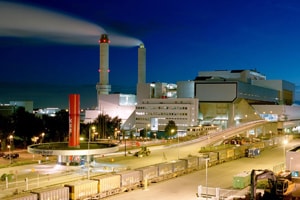
The plant has “very, very low emissions” he said, with it aiming for the reuse or recycling of almost all outputs. And, it has a high electrical efficiency at about 30%. A higher level of 33% could be reached, but the strategic advisor said that with low electricity prices and more damage at this level to turbines because of high temperature steam, the plant was unlikely to go above the 30% efficiency level. An added factor was that the Dutch government paid a subsidy at 30% production but not above.
There is public support for the AEB plant, noted Mr Simoes. “To the citizen the message is that when you give the grey bin waste to AEB, you get something back.
“All the electricity needed in the city is coming from AEB. Also there is heat. Sixty thousand households are connected, the ambition is to move to 233,000. Togther with other gas fired power plants we are the main source of district heating in Amsterdam.”

Register for free to comment