


As a Packaging Recycling Note (PRN) trader and market analyst, 2026 has been one for the record books. In the almost 30-year history of the PRN system, there has never been a situation like this.
Put simply, there will not be enough PRNs this year. That means that obligated producers and packaging compliance schemes will not be able to fulfil their legal obligations. It will be the first time since the regulations began in the late 1990s that the UK will likely fail to meet its legally binding recycling targets.
Uncharted doesn’t quite cover the magnitude of the situation.
Today, we finally got confirmation that Defra and the regulators will intervene. The regulators of the four nations will issue Regulatory Position Statements (RPS) confirming that obligated producers and compliance schemes will face no enforcement action if they only procure a given percentage of their material-specific recycling obligations.
So, what does it all mean and how did we get here? Read on below to find out.
How did we get here?
The early part of the year was characterised by regulatory change and system issues.
On the first of January, the rules around issuing export PRNs (PERNs) changed. Whereas previously an exporter could issue evidence at the point of export, this was changed to the point of receipt by an accredited overseas reprocessor.
This was a welcome change as it puts tighter guardrails around the system and makes it harder to commit fraud. Even so, the downside of this change is that export-heavy materials like paper and plastic had impacted supply during the early months of the year. Paper, around 70% of which gets exported, demonstrates this well. In Q1 the ‘waste balance’ (the number of PRNs issued or able to be issued) was 515k whereas in Q2 it had almost doubled to 958k.
A further issue in the early months of the year was that the new ‘Record reprocessed or exported packaging waste’ (RREPW) system was not ready in time, with no one able to issue PRNs until late February. There were also delays in accreditations being granted by the regulators, with reprocessors and exporters unable to backdate tonnage if they had missed the registration cut-off date.
While we had a functioning market by the end of February, we had no supply data (an essential requirement for gauging the risk of non-compliance for a given market). The first snapshot was published in May, but it was not a true reflection of supply and was heavily caveated.
Credited ‘waste balances’ were added to the report at the end of July, which gave us our first detailed look at year-to-date PRN supply. As I noted at the time, key materials like plastic looked to be on track to fail compliance.
In an email to market participants on 30 July 2026, the government and regulators confirmed that they “may consider appropriate mitigating actions” should there be a “material risk to meeting the 2026 producer recycling obligations”.
Three months’ later, we now have confirmation that there will be an intervention.
How will the intervention work?
The intervention is focused on plastic, wood and steel; other materials are not affected as these markets are deemed to be likely to comply. While obligations will technically stay the same, the number of PRNs required to comply with the RPS is lower. A worked example is given below.
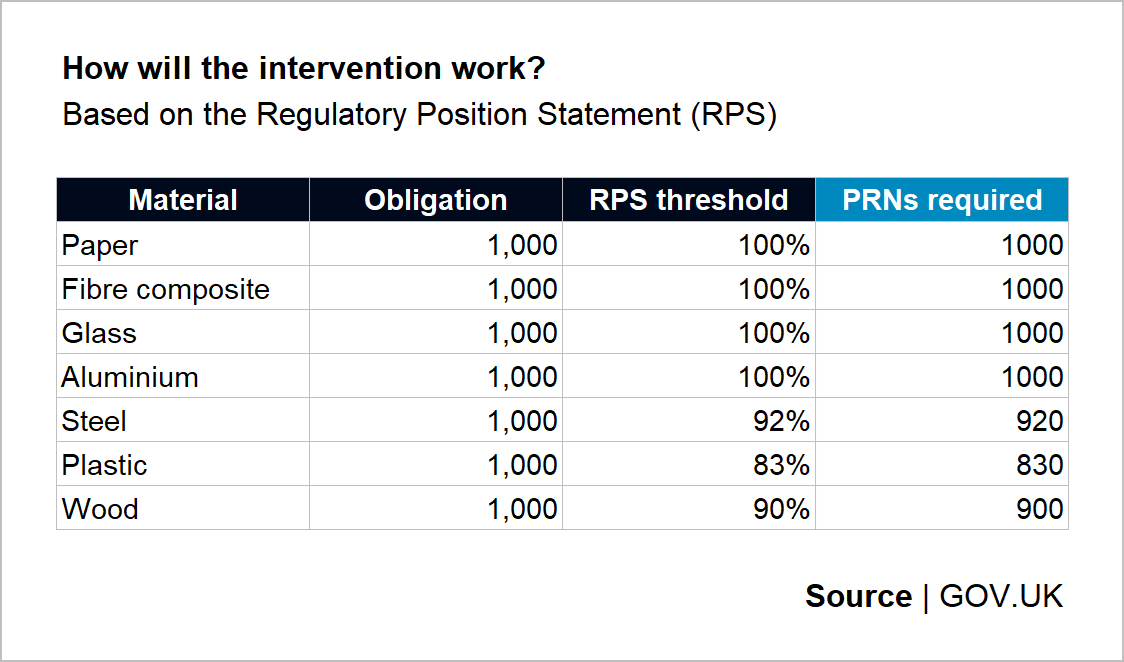
It is important to note that producers and compliance schemes will technically be non-compliant unless they buy all their PRNs. The RPS is simply a mechanism to say that the regulators will not undertake enforcement action against those who only buy the amount required under the RPS.
This is an important point, and one that will concern the 14 registered compliance schemes, given that compliance has always been their raison d’être. Ecosurety’s position will be to comply with the RPS, as buying the entirety of our obligation would mean unnecessary costs for our members and increase the risk that there will not be enough PRNs for other compliance schemes and producers to buy.
What do the market fundamentals say?
The latest supply report covers the first eight months of the year. To that we can also add the ‘carry-in’ from last year (December PRNs that were accepted into compliance year 2026). We can then compare this to the RPS-revised UK obligation to gauge the state of the markets.
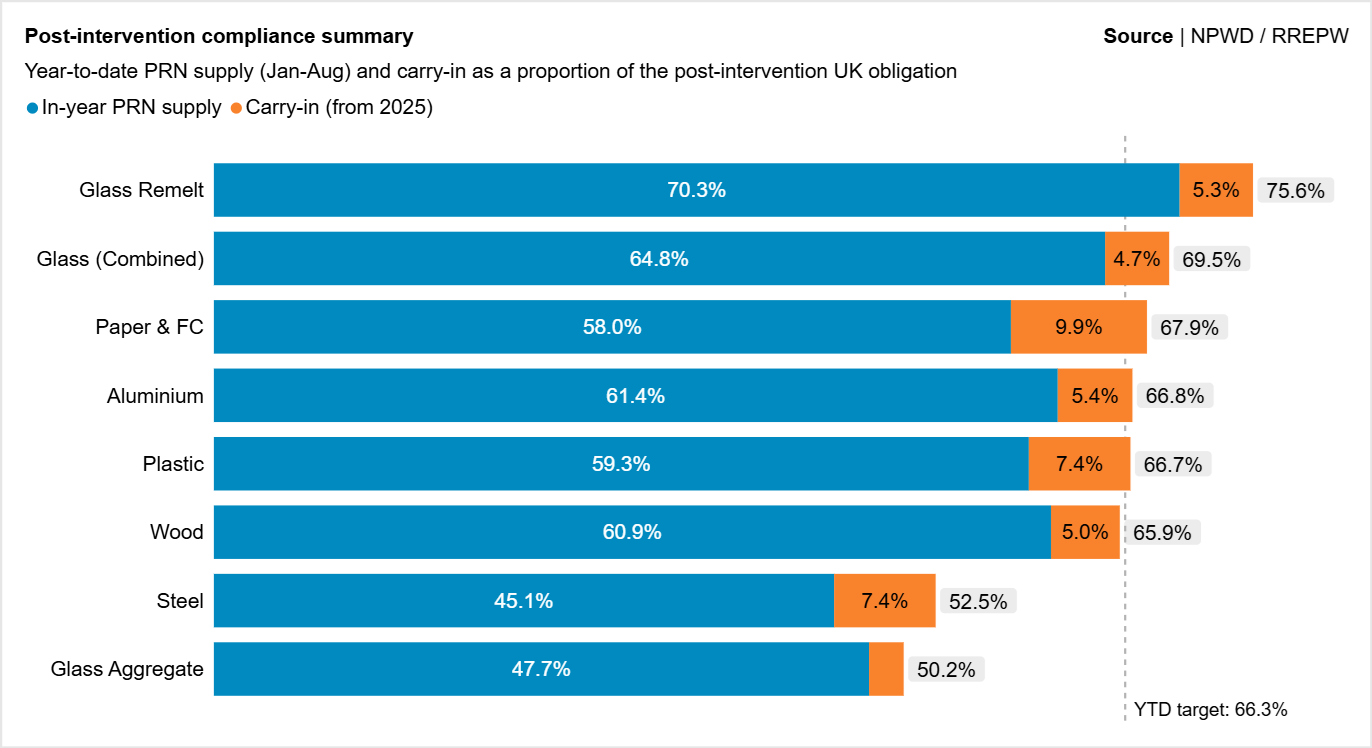
With eight months of data, we should have achieved around 66.3% of the RPS-revised obligation. Plastic and wood still look tight in this view but are much closer to target than previously. Steel is roughly 14% behind target, so Defra and the regulators must expect supply to pick up substantially in the latter months of the year.
It is worth noting that 61 accredited organisations currently have outstanding data submissions, so the real picture could look a quite different. The extent to which is not yet known.
The other materials look to be on track to meet compliance, although aluminium will need a strong end of the year in order to do so comfortably. Glass aggregate continues to have the worst performance, but a sizeable overperformance in glass remelt will more than cover the shortfall.
How will the markets react?
This is a difficult one to call. In theory, there is now less compliance risk than before, and the supply-demand equation looks more balanced – at least for plastic and wood. However, there is still risk.
Prices should soften somewhat, as the fundamentals now look more positive, but a significant correction will likely require an improvement in the underlying supply position. This is where new entrants will be crucial. Indeed, there have been 16 new accreditations granted in Q3, with a further 19 currently awaiting accreditation. With more market participants able to issue evidence, supply should improve and we will hopefully move closer to target as the year progresses.
Even so, we are not out of the woods yet. There is still a long way to go until the end of the year – and further uncertainty is a distinct possibility.
Looking forward
Given that the compliance position in 2026 now looks less existential than previously, we might be forgiven for breathing a collective sigh of relief. However, there are several unknowns still on the horizon.
Firstly, there is a risk that the tightness of certain markets will substantially reduce the ‘carry-out’ from 2026. With more December PRNs being used in compliance year 2026 out of necessity, we could lose a lot of the ‘buffer’ going into 2027. That means we could start the year with weak supply and therefore higher prices.
From a demand perspective, it is worth also thinking about next year’s recycling targets. As it currently stands, targets will increase by 1-2 percentage points across all materials. While this will be largely welcomed in markets such as glass, where supply this year has been strong, it will add further pressure to already stressed markets like plastic.
We also have the planned introduction of the UK Deposit Return Scheme (DRS) on 1 October 2027. This will essentially remove around 15% of plastic and 75% of aluminium packaging from the PRN system. Reprocessors will need to focus on harder to recycle formats like aerosol cans and plastic trays to maintain PRN supply.
Taken together, Defra and the regulators may need to revisit the 2027 recycling targets to make sure another 2026 doesn’t happen. This will likely require amending primary legislation, which is often a lengthy process. We might therefore start the year not knowing what the final targets will be.
While it is hoped that 2027 will not be as arduous as 2026, how the PRN system will navigate yet more uncertainty remains to be seen.

Register for free to comment