

The UK technology company has spent more than a decade developing a cleaner, safer and lower energy salt-based carbon capture process different from conventional amine-based systems.
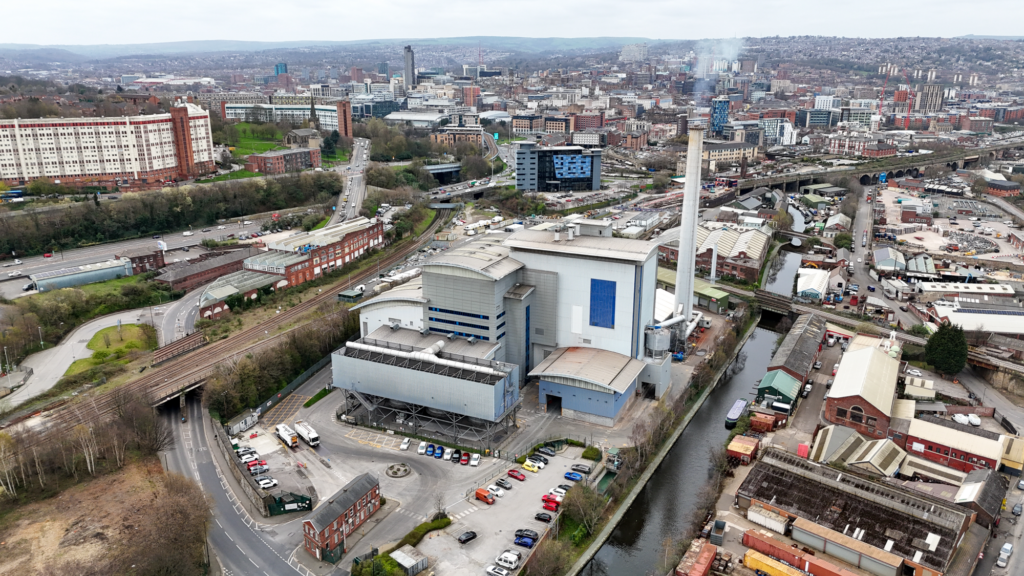
Its latest demonstration unit has operated on Energy from Waste (EfW) flue gas at Veolia’s Sheffield Energy Recovery Facility (ERF), with more than 1,500 hours of operation on EfW gas and more than 1,000 hours continuously.
But according to C-Capture’s Commercial Director Greg Searle, proving the technology works is no longer the challenge.
The company is looking to raise funding and secure a suitable site for its next, first commercial-scale deployment, which it sees as the bridge towards multiple large-scale commercial deployments.
Speaking to letsrecycle.com, Searle explained that the company is now facing what he described as the “valley of death” between demonstrating a technology and deploying it commercially.
The technology behind C-Capture
C-Capture came out of a discovery made by a post-doctoral researcher working at the University of Leeds in 2012, when they first discovered a new salt-based chemistry which could capture carbon dioxide (CO2).
The technology subsequently attracted substantial investment from BP and Drax, alongside government support.
C-Capture’s process uses a non-amine salt solution which reacts with CO2 and then releases it during regeneration. The chemistry forms a weaker bond with CO2 than conventional systems, meaning less energy is required to release the captured gas.
That is significant for EfW plants, where steam or electricity generated by the plant has to be diverted to operate the carbon capture system.
Searle explained: “The largest cost in carbon capture comes from the energy needed to release the CO2 after it has been captured.
“C-Capture’s process needs 40% less energy than an equivalent amine process, this is a massive saving that we estimate to be over £30 per tonne (CO2) – for a typical EfW plant producing approximately 300,000 tonnes a year of CO2 this worth at least £9 million per year and our process is safer and cleaner.”
According to the company, its salt-solution is also non-hazardous and biodegradable, with degradation products that are environmentally benign.
Searle added: “If there is any capture agent regeneration required, the byproducts from the process would be useful chemicals, not hazardous waste products.”
From setback to Sheffield
The development programme has not, however, been straightforward.
C-Capture has attracted more than £30 million of investment during its 10-year development journey, but at the end of 2024 both BP and Drax subsequently stepped back due to changed business priorities as the wider development of carbon capture projects moved slower than anticipated.
For C-Capture, the timing was particularly difficult. The company had reached the point where it had demonstrated the technical and commercial viability of the technology, only for the investment environment to become more challenging.
Searle explained “At the point the technology had started working reliably at commercial conditions (technically de-risked), BP and Drax stepped back. And as a result, the company had no choice but to make everyone redundant.”
Given the technical success, a small group of now ex-employees set about trying to save the technology. Sir Warren East was the Chairman of the company at the time and made the financial investment that enabled the rescue to happen.
East commented: “When BP and Drax stepped back, the technology was on the point of a major operational breakthrough that effectively de-risked the commercial scale.
“I felt it was important that this innovative UK technology was given the chance to demonstrate its safer, cleaner and lower-energy credentials through operation on real flue gas and show what it could achieve at commercial scale.”
Veolia supported the rescue by hosting the demonstration unit at their Energy Recovery Facility in Sheffield.
The fully-integrated demonstration unit that had been built in a remote shed on Drax’s site was designed in conjunction with BP specifically to de-risk the commercial scale-up, using standard oil and gas processing equipment already proven at mega-scale to avoid all engineering scale-up risk.
The unit included all process steps, all the recycle loops, all the sensors and all the on-line analytical equipment.
There was just one important step required – the unit had never operated on flue gas – which is where Veolia’s EfW flue-gas came in.
The company had previously operated smaller Carbon Capture Solvent Compatibility Units on flue gas from glass, EfW, biomass and lime facilities. Those trials were intended to demonstrate the capture system’s tolerance across different hard-to-abate industrial sectors.
Sheffield provided a different level of validation. The challenge was no longer whether the chemistry could capture CO2, but whether the complete process could operate reliably, at scale, at commercial conditions, alongside an industrial plant.
The Sheffield trial has now given C-Capture what it considers to be unequivocal proof of their process’s performance – the last step before commercial deployment.
Crossing the ‘valley of death’
Searle said: “There is nothing more C-Capture can do technically to de-risk this technology other than build and operate a bigger one.”
That requires significant capital, an industrial site willing to host the technology and importantly a use for the CO2 produced.
The issue, Searle said, is not that the technology has failed to attract interest, but that investment has become harder to secure at the point when the company needs to build a first commercial scale unit.
Government support has traditionally played an important role in helping emerging technologies make this transition, but Searle argued that funding in the carbon capture space is now being focused on a relatively small number of large-scale carbon capture projects.
For smaller technology developers, that can leave a gap between research funding and the capital required for commercial deployment.
He commented: “That valley of death is the one that I’m trying to work through. Historically, the government would hold competitions for grant funding towards the capital cost of exciting new technology scale-up projects.
“Winning this funding would de-risk a project massively for anybody that’s going to invest and come in. Sadly, the government is no-longer holding these competitions.”
The company is currently seeking around £2.5 million to support its next stage of development, alongside a site where the first commercial deployment can take place.
For C-Capture, the technology itself is now substantially de-risked. The remaining question is whether the investment and policy environment can move quickly enough to allow it – and other emerging carbon capture technologies – to make the jump.

Register for free to comment