


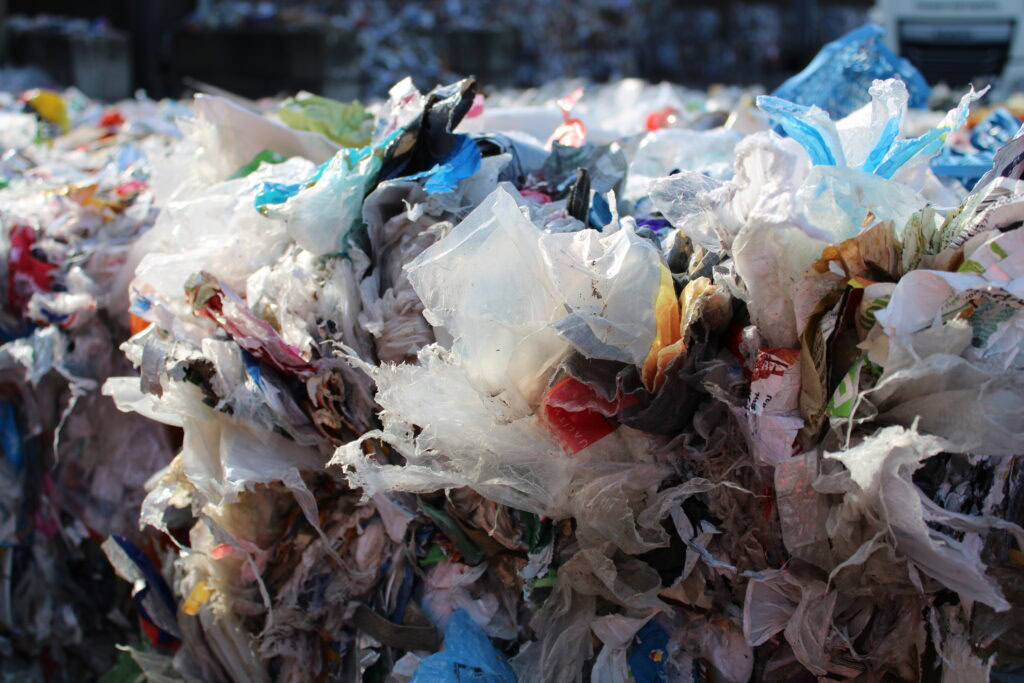
The nine-month trial ran from spring 2025 to December 2025 across Swansea Council and the Vale of Glamorgan Council.
According to WRAP, it aimed to explore how flexible plastic could be collected from Welsh households, identify the challenges and opportunities associated with the material, and provide evidence to inform future policy, including extended producer responsibility (EPR) proposals and updates to the Welsh Collections Blueprint.
The Welsh Government has confirmed it remains committed to introducing the kerbside collection of flexible plastics from 2027, despite the delays to England’s scheme.
The trial covered 45 collection rounds across the two authorities – 12 in Swansea and 33 in the Vale of Glamorgan.
Households were provided with rolls of blue, single-use bags made from 100% recycled content and asked to place empty plastic bags and wrapping inside before tying the bags securely.
The trial targeted polyethylene (PE) and polypropylene (PP) packaging, broadly aligning with the materials covered by England’s Simpler Recycling reforms. Items including cling film, food pouches and film lids from food trays were excluded.
J & A Young (Leicester), trading as Jayplas, was appointed through a competitive tender to reprocess the material.
Flexible plastic trial results
The trial collected between 2 and 2.5 tonnes of flexible plastic each week from each local authority, exceeding the initial assumptions of 1.44 tonnes per week in the Vale of Glamorgan and 1.94 tonnes in Swansea.
The most common materials collected were mono-PE, followed by mono-PP and PET twin-layered material.
However, participation and capture varied significantly between the two areas.
In Swansea, 57% of the targeted flexible plastic found among participating households was presented in the collection bags, compared with 70% in the Vale of Glamorgan.
The report estimates that this translated into an overall capture rate of 28% in Swansea and 50% in the Vale.
These figures were lower than the average capture rate for other dry recyclable materials in Wales, which was around 84%, with capture ranging from 70% for non-ferrous metal packaging to 92% for glass.
The trial recorded average participation of around 60%, with participation at 49% in Swansea and 71% in the Vale of Glamorgan.
The report notes that the higher participation in the Vale may in part have been linked to the authority providing a weekly collection, compared with Swansea’s fortnightly service.
Reasons given anecdotally by residents for not participating included the perception that the collection was only a trial and would not continue, as well as households running out of collection bags.
Colin Smith, Head of Neighbourhood Services at Vale of Glamorgan Council, said: “The Vale is renowned as a place that cares about the planet, where people do all they can to support new ways of recycling.
“That is why WRAP Cymru decided we should be one of the first areas in Wales to pilot this recycling method.”
High-quality collections
Despite the relatively low capture rates, the material collected was found to be of high quality.
An average of 76% of material received was recycled, while the purity of both PE and PP was around 95%.
Jayplas said the results were better than expected for material collected at the kerbside without pre-sorting and that the quality was comparable with flexible plastics collected through supermarket front-of-store schemes.
Across Wales, the report estimates that if the trial’s collection yield were replicated, around 9,000 tonnes of flexible plastic could be collected each year.
This could increase the Welsh recycling rate by around 0.5 percentage points.
Infrastructure and costs
The report also considered the infrastructure and costs associated with introducing flexible plastic collections more widely.
Both authorities required modifications at their waste transfer stations, including additional sorting arrangements. The Vale of Glamorgan purchased and installed a separate baler.
The report warned that requirements will vary between sites, with older or smaller waste transfer stations potentially requiring greater investment.
Its cost model for a hypothetical Welsh local authority with 63,000 households estimates a first-year cost of around £604,000, falling to around £402,000 from the second year.
This equates to approximately £9.59 per household in the first year and £6.38 thereafter.
The model assumed the use of existing collection vehicles and staff, but includes costs for waste transfer station modifications, a baler, additional staffing and flexible plastic processing.
However, the figures do not take account of savings from removing flexible plastic from residual waste.
The report noted that moving flexible plastics out of residual waste could reduce disposal costs, with the potential for further savings associated with future emissions trading scheme (ETS) charges.
It also stressed that costs are dependent on participation and tonnage, while there remains considerable uncertainty around future reprocessing gate fees.
The report concluded that flexible plastics can be incorporated into existing kerbside services using dedicated collection bags, but said that wider rollout will require consideration of infrastructure, staffing, communications, procurement and available recycling outlets.
At the end of the trial, Swansea decided to continue its flexible plastic collection in the trial area, while the Vale of Glamorgan planned to extend the service across the county from April 2026.

Register for free to comment