


It seems strange to invoke Tony Blair’s 1997 declaration of electoral victory in a 2026 article about the PRN markets, but there is some relevance. 1997 was the year in which the original Producer Responsibility regulations were passed, paving the way for the creation of the PRN system as we know it today.
As of last week, with the publication of “credited waste balances” and the first detailed picture of PRN supply since the transition to the new “Record reprocessed or exported packaging waste” (RREPW) service, we are very much in a new era for the PRN markets.
How did we get here?
2026 began with unprecedented uncertainty. The new RREPW system was not ready in time, so we began the year with no one able to issue PRNs. This functionality was added in February, but it was not until May that we got our first look at supply data. Even then, it was not a true reflection of supply – and was full of caveats.
Last week, the PRN supply report was updated to include the first six months of the year and, crucially, included the total tonnage credited to operators’ waste balances. This essentially gives us the “tonnage on which PRNs can be issued” (whether they have been issued or not).
Put simply, we now have a detailed view of PRN supply and can model the market dynamics with more confidence.
The market fundamentals at the half-year point
The latest supply report covers the first six months of the year. As such, we should have generated enough PRNs to cover around 50% of the annual UK obligation, which is the sum of individual producer obligations.
We also need to factor in the “carry-in” from last year: December PRNs that were accepted into compliance year 2026. By combining these various data points, we can gauge the state of the markets.
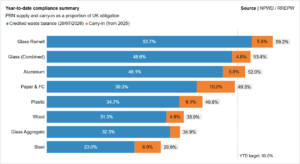
At present, only glass remelt is on track to meet in-year compliance (achieving obligation without the need for carry-in). In terms of overall compliance, inclusive of carry-in, we can see that glass (overall) and aluminium are ahead of target. Paper and fibre composite is within touching distance, but needs the entirety of the carry-in.
The other materials look to be very tight. Plastic, wood and steel are on track to fail compliance. This is also the case with glass aggregate, but a likely surplus in glass remelt should cover the shortfall.
Crucial nuance
If read at face value, the data indicates a likely shortage of PRNs in key materials this year. However, two key factors are worth bearing in mind.
Firstly, the dataset is not complete. Of the 357 organisations that hold a valid accreditation, 65 have not submitted complete data for the period. In most cases this is for the most-recent month (June), but there are still 26 with outstanding submissions from earlier periods. There are even a handful who have yet to submit any data whatsoever.
Beyond this, there are currently 24 registered organisations awaiting accreditation. If approved, these organisations could then issue PRNs. This would be a welcome boost for supply later in the year.
Secondly, we should not underestimate the significance of January’s export rule changes. Whereas previously a Packaging Export Recycling Note (PERN) could be issued at the point of export, this was changed to the point of receipt at an accredited overseas reprocessor. This meant that an intercontinental shipment sent in January might not have reached its destination until March or even April.
This appears to have impacted export-heavy materials like plastic. For example, plastic exporters were able to issue 12,705 tonnes of PRNs in January compared to 52,698 tonnes in April. This initial supply impact is borne out in the Q1 data, but subsequent quarters should be less impacted.
Overall, there are enough factors to suggest that the market fundamentals might not be as bleak as they look. Late submissions will improve the situation, and hopefully waste arisings will increase over the summer and winter months.
Even so, price rises seem inevitable – at least in the short term – for materials like plastic, steel and wood.
The spectre of intervention
In an email to market participants on 30 July 2026, the government and regulators confirmed that mitigatory action could be sought if the risk of non-compliance continues:
“If the ongoing data review and stakeholder engagement activities indicate a material risk to meeting the 2026 producer recycling obligations, the four governments, in collaboration with the regulators, may consider appropriate mitigating actions.”
While proactivity is welcome, the prospect of market intervention presents something of a dilemma for market participants.
From a purely compliance perspective, it would be prudent to try and close key exposures early to mitigate supply shortages and guarantee compliance. Yet from a financial perspective, others may hold back in the hopes that recycling targets – and, thus, their obligations – might be lowered.
Neither choice is without risk, nor does there seem much consensus on how best to proceed.
So, what should we do?
Until our collective confidence in the data grows, and the actual risk of non-compliance becomes clearer, it may be wisest to keep a calm head. Significant moves can be highly disruptive in illiquid markets, while panic can spread quickly around the relatively few market participants.
Defra and the regulators are proactively trying to resolve the issues and improve confidence in the system. While the situation is far from ideal, it’s the situation we find ourselves in. Regulatory and systemic change is never easy, yet the markets have weathered previous storms and proved resilient.

Register for free to comment