

As the government announced support for food waste collections in its new waste strategy last week, (see letsrecycle.com story), the UK's first city to offer food waste to all residents said its recycling rate had subsequently shot up from 18% to around 37%.
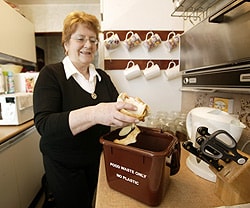
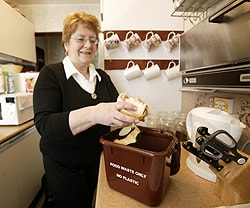 Bristol residents are given kitchen caddies to take out their food waste to their larger bins |
Sean Spencer-Wort, waste minimisation and recycling offer for Bristol council, said that the weekly service had also made it easier for the council to introduce fortnightly collections – by providing a weekly method of disposing of smelly food waste.
He said: “I'm not surprised that the strategy supports food waste collections, as it is a way to get around the furore of alternate weekly collections. I would especially recommend it for urban areas where food waste makes up a large part of the waste stream.”
“On a month-by-month basis our recycling rate has increased to around 36-38% and the vase majority of the increase is from food waste and card. With LATS on the horizon every council will have to look at least look at food waste collections,” he added.
Collections
In Bristol, the council rolled out food waste collections in two phases in 2006 to 150,000 households (see letsrecycle.com story). The scheme sees residents using a kitchen caddy and a 25 litre brown bin for food.
At the same time, it rolled out a weekly collection of card, a paid-for green waste service and slashed its residual waste collections in half to every fortnight.
The green waste and card are collected together with the food and processed together at New Earth Solutions' in-vessel composting facility at Wimbourne in Dorset.
Although it is often more expensive to process food waste with other materials, due to the need to process it all in line with Animal By Product Regulations governing food, Mr Spencer explained it made sense in Bristol.
He said: “We have to pay the higher in-vessel composting gate fee for all the material but if we collected the material separately we would need more vehicles which would have to travel all the way to Dorset and more staff, so it works out cheaper on balance.”
Analysis
Mr Spencer explained that the council did a refuse analysis and found that the element of food was much higher than that of green waste as it was an urban authority.
| Related links: |
He added that by getting residents to separate their card, food waste and garden waste out the council had the option to change its collections if needed.
He said: “We looked at both options and we can always change the system if needed. We are looking to put out a tender to see if we can treat out food waste more locally.”

Register for free to comment