

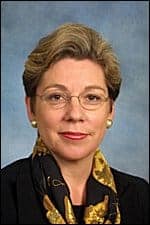
Waste and Resources Action Programme chief executive Jennie Price told letsrecycle.com today: “One of the most important things we have got to do in 2003-04 is make sure that the research that we have focused on will end up as products in the market.”
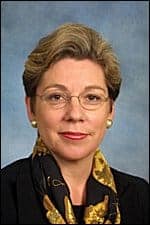 Jennie Price, WRAP chief executive |
WRAP was established in 2001 to develop markets for recycled products, but its focus for the first two years was on research and development. It currently funds 37 research programmes.
But as the organisation launched its Achievements Report for 2002/03, Ms Price said: “It’s very easy to produce reports, put them on the shelf and go on to the next project. We must now encourage the commercial exploitation of products.”
WRAP will carry out the change by communicating with the decision-makers in the engineering and architectural industries. And as most of the organisation’s research work has focused on glass, this sector will be most affected by its promotion of the research to markets, Ms Price said.
Achievements
Securing State Aid clearance for key funding programmes was WRAP’s greatest achievement in the past year, Ms Price said. This will allow it to develop its Equity Investment Fund and Lease Guarantee Schemes in 2003/04.
In order to protect competition, the European Commission must give State Aid clearance to a government before it can give any business more than 60,000 worth of grants.
Ms Price said: “The State Aid clearance was incredibly important for us because if we didn’t demonstrate that we could give some grants through this aid, it would have made it very difficult to operate the schemes.”
The Pilot Equity Fund is more than 5 million that is intended to provide equity for early-stage SMEs in the recycling sector, which can have problems raising finance because they are trying to raise relatively small amounts. It should help lever in twice as much money again from private investment.
The Lease Guarantee Scheme will guarantee 40 million of assets to SMEs on certain types of plant and machinery. It is aimed at countering problems caused by banks hesitant about lending to companies without long track records or which use innovative technology (common in the recycling industry).
During its second year, WRAP received 15.6 million grant funding for its market development programme, and 555,000 for its Aggregates Programme, which mainly came from DEFRA.
Its other achievements included initiating 13 new research and development projects to identify uses for recycled materials and introducing a Publicly Available Specification standard for compost.
Future
WRAP’s original remit lasted until 2004, but has now been extended to 2006. After the first stage plans are completed, Ms Price said that the organisation would concentrate more on developing “break-thorough technology”.
She explained: “For the first three years, we have been trying to make existing technologies and ideas work a bit better. Next year we will be trying to do completely different things. Plastics recycling is a very good example of that – some of the technologies are not there yet, we just don’t know how to develop some polymers into usable materials.”
The Achievements Report 2002/03 is available on the WRAP website.


Register for free to comment