

The proposal was among those put forward by the Environment Agency as part of its draft Fire Prevention Plan, originally published in 2015, which sets out measures waste site operators must take in a bid to prevent fires.
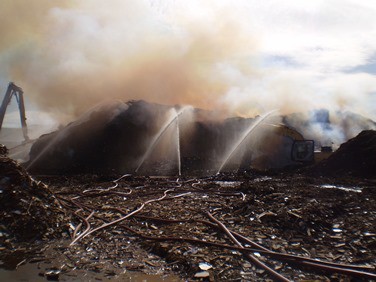
However, the WRA has called for the proposal to limit the amount of time that material can be left to burn to four hours to be scrapped.
The organisation claims that ‘too much emphasis’ has been placed on the measure, and is instead calling for new guidance to focus on encouraging operators to improve detection of fires.
Circumstances
According to the WRA the proposed three to four hour burn time does not take into account individual site circumstances such as tonnage, material types, weather conditions and local fire-fighting strategies.
It adds that tactics to tackle fires should be decided by the fire and rescue services rather than the Environment Agency.
Andy Hill, chairman of the WRA and market development director of Suez UK, said: “The Environment Agency has issued a bulletin indicating that the four hour burn time will remain in the new Fire Prevention Plan (FPP) guidance.
“We have never been sure where this time limit came from or how the figure was arrived at. Once again, it would appear that subjective opinions are getting in the way of scientific fact.”
Burn time
Mr Hill added that the WRA would like to see the evidence used to dictate the four hour burn time proposal developed by the Agency.

He said: “It is impossible to dictate on paper how long a fire can burn for. There are so many factors to consider, including the type of material, the location of the site, the time of year etc. The only way to determine a safe outcome for any of these factors is for the fire and rescue service to assess each situation on an individual basis as an incident occurs.”
The FPP guidance sets out different restrictions for different waste materials. Anaerobic digestion facilities, for example, are effectively exempt from having to draw up a FPP, but for operators dealing with waste wood, tyres, scrap metal and WEEE that is not the case.
FPP
Members of the WRA, which claims to represent 80% of the industry have previously been encouraged to write to their local MP’s to oppose some of the FPP proposals (see letsrecycle.com story)
The guidance on storing waste materials was released by the Agency last year, setting out a number of stipulations on wood pile sizes, separation distances between piles and the amount of time for which material can be stored for.

Register for free to comment