

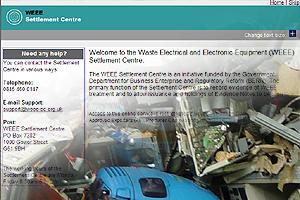
Run by Glaswegian IT firm Real Time Engineering, the Centre is an online facility for those collecting, treating and recycling WEEE to record the electronics they have recycled. It ultimately allows manufacturers and importers to show that they have carried out their producer responsibility to recycle WEEE.

The Department for Business, Enterprise and Regulatory Reform (BERR) wrote to local authorities, collection site operators, recyclers and producer compliance schemes over the weekend to let them know they can now use the Centre to issue their recycling evidence.
Kath Barker, from the WEEE implementation team, said: “Evidence should no longer be submitted to BERR via the WEEE evidence box at WEEE.evidence@berr.gsi.gov.uk. Evidence already submitted to this address will be transferred directly to the Settlement Centre.”
However, the trading element of the Settlement Centre is not yet live, and will come online later this month.
Ms Barker explained: “The third stage of the system will add evidence trading mechanisms and should go live during December. Users will be asked to participate in a testing phase pre- go live date. Further enhancements of the system will be added early in the New Year.”
These further enhancements will be changes related to the amended WEEE Regulations expected to go before Parliament later this month ready for the 2008 compliance year.
This could include a revision of the requirement for the Settlement Centre to deal only in whole tonnes, a situation that has led to industry concerns about data inaccuracy and the cost impact of being unable to trade less than a tonne of recycling evidence.
Evidence
Under the WEEE Regulations, all WEEE – either household or business – that has been separately collected and dealt with on behalf of a compliance scheme now has to be reported to the Settlement Centre.
This is done by approved authorised treatment facilities (AATF) or approved exporters (AE) entering the evidence data from any of the 13 categories of WEEE handled onto the Centre's website. Each firm has an account on the system that shows how much evidence they have entered.
Guidance sent to treatment and export firms states that evidence must be entered onto the system within 28 days of the equipment being recycled. It will be up to the producer compliance schemes that have delivered that equipment to the treatment/export firms to ensure this evidence is logged on the system in time, the government warns.
The evidence logged onto the system can then be used by the producer compliance scheme to show that its members' recycling obligations have been carried out. Schemes will also have their own accounts on the system. Only the enforcement agencies and BERR officials will have access to any account that is not their own individual account on the Settlement Centre. However, the Centre will show publicly how much WEEE has been logged onto the system.
If a scheme doesn't have enough household recycling evidence for the compliance period – or has too much – relative to its members' obligations, it will soon be able to trade with other schemes to balance the books. Evidence for business-to-business WEEE cannot be traded between schemes.
The Centre itself will not be a platform for trading – any trading must be through agreements made outside the Centre, with the Centre adjusting the levels of evidence between two schemes' accounts on confirmation of an agreed trade.
At the end of a settlement period, schemes will then submit a Declaration of Compliance certificate to the Agencies to state that they have collected enough WEEE to meet their members' obligations, or have purchased evidence to cover any shortfall.
Recovering costs
Recyclers and exporters will not be able to trade in evidence, although local authorities who have not yet contracted with a compliance scheme to collect WEEE will be able to trade evidence and recover their recycling costs.
The government has also said that in the event of a dispute between a council and a compliance scheme, where sites have not been cleared of WEEE by the scheme, councils will be able to use the Settlement Centre to recover their costs from other schemes interested in buying the WEEE evidence. In such a case, local authorities are advised to inform BERR officials immediately of any dispute in order to access the Centre.
Likewise, local authorities that were late in signing up a compliance scheme can use the Settlement Centre to trade evidence for the first compliance period. But, they must inform BERR about their individual requirements for doing so, showing BERR why they could not sign up a compliance scheme any sooner.
However, operators of designated collection facilities (DCFs) who are not local authorities cannot use the Settlement Centre to recover recycling costs, the guidance warns. They must have an agreement in place for a compliance scheme to collect any WEEE arising at their sites.

Register for free to comment