

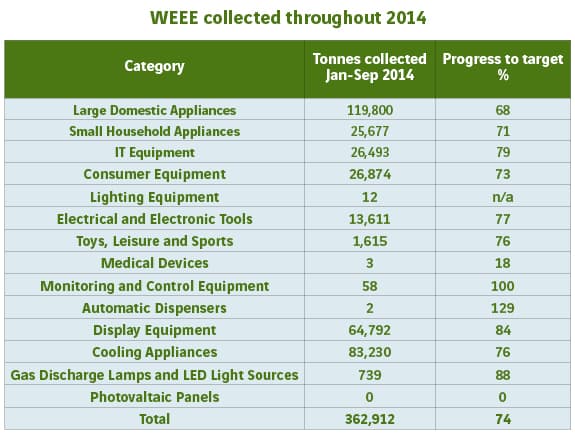
Data outlining the collection rates for the third quarter of the year (January to September) was published by the Environment Agency yesterday (December 2) and shows that a total of 362,912 tonnes of WEEE have been collected throughout the year.

This means that to date, the sector is just shy of three quarters of the overall collection rate needed to meet the target set by the Department for Business (BIS) in March (see letsrecycle.com story).
Compliance schemes have claimed that they are confident that collections will increase in the final quarter of the year to address the shortfall, with more WEEE likely to be available due to an increase in spending by consumers over the Christmas period, and more ‘household’ WEEE being available due to change in guidance on B2B and B2C WEEE.
Despite the positive progress towards the overall target a shortfall in the volume of large domestic appliances (LDA) – items such as washing machines and tumble dryers – is likely to be of some concern for compliance schemes.
To the end of September a total of 119,800 tonnes of LDA have been collected, with a target to collect 172,000 tonnes throughout the year. This means that a total of 52,200 tonnes of WEEE will need to be collected during the final quarter of the year, 10,000 tonnes more than during any other quarter throughout the year.
Collection
Schemes that are obligated to collect LDA to meet the recycling obligations of the producer members are likely to have to pay a ‘compliance fee’ if they are unable to secure the required tonnage to meet their targets.
Conversely, schemes collecting material above their obligated collection tonnage – particularly gas discharge lamps, for which 88% of the overall collection target has been met – will be unable to transfer surplus WEEE evidence that has been collected.
Commenting on the data, James Champ, compliance specialist at ecosurety, formerly Budget Pack, said that the tonnages of LDA available are expected to increase before the end of the year.
He said: “As we saw in Q2, category 1 is below where we would like to see it at this stage in the year. With the Christmas period upon us, however, we anticipate an increase in WEEE from large household appliances as consumers will be purchasing Christmas gifts to replace older models which will be disposed of.
“We also anticipate an increase in the overall amount of B2C WEEE collected as we approach the end of the year. This follows from the revised interpretation of ‘WEEE from private households’, issued by the Environment Agency on November 5, which now allows AATFs to report WEEE as B2C – where there is evidence that it is likely to be used by both private households and other than private households.”
David Adams, managing director of Clarity Environmental, added: “There are no big surprises in the quarter three data, with either the amount of EEE placed on the market or of the amount of WEEE being collected. Collections have increased each quarter and we will need to reach a similar level in the final quarter of this year, to ensure the UK reaches the 490,000 tonne target.
“So far, the figures on both collections of WEEE and amount of EEE placed on the market in 2014 has followed a similar trend to last year. We continue to se the effect of the move to LED, LCD and plasma screen technology, with the amount of display equipment collections again this year from 2013, against an increase in the amount of products placed on the UK market.”

Register for free to comment