

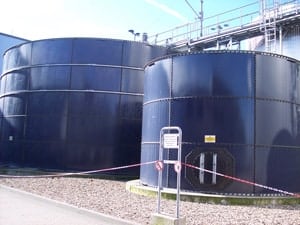
The water industry must be wary of causing tensions with the waste sector as part of its push for increased co-digestion of sewage sludge with other organic waste through anaerobic digestion.
That was the message from former president of the water sector trade body the Chartered Institution of Water and Environmental Management (CIWEM) at a conference on waste infrastructure in central London yesterday (March 29). The event was hosted by legal firm Norton Rose.

Ken Shapland, now of Kenviros Consulting, outlined the water sectors desire to see increased levels of co-digestion of sewage sludge and other organic waste materials in water sector-run anaerobic digestion (AD) plants. But, he acknowledged that this could lead to tensions with the waste sector.
In particular there are concerns as raised in an Ofwat update of the research published last month that the water sector could have an unfair advantage over the organics recycling sector. This is due to the infrastructure and expertise water companies have access to, which is paid for by customers.
He said: There are a host of questions around this [co-digestion]: is it an important relationship? Is it competitive? Is it going to cause tensions? What we really want to get to is a level playing field and there must be some way we can do that to create an economic benefit.
Mr Shapland added that diverting organic waste into existing AD plants run by water companies as opposed to AD plants operated by organics recycling firms would help limit the costs needed to develop new sites and lengthy construction periods.
Assets
At the request of waster regulatory body Ofwat, the issue of co-digestion is currently being studied as part of an on-going investigation into the organics recycling market being carried out by the Office of Fair Trading (see letsrecycle.com story).
Mr Shapland said that part of the reason that Ofwat was pushing the issue was because water companies would be able to claim a higher level of Renewable Obligation Certificates (ROCs) from the use other organic feedstock.
At present, sewage-derived gas is only eligible for 0.5 ROCs per MWh, while the anaerobic digestion of organic feedstock is eligible for 2 ROCs per MWh.
Furthermore, he said that the use of co-digestion could help reinvigorate redundant assets in the water industry, such as small-scale or regional anaerobic digestion plants, which have been marginalised as companies sought to centralise operations in recent years.
However, he said that there would be the need for regulatory change to help stimulate an increase in co-digestion.
Some companies are already pursuing co-digestion and some water companies are hoping to go towards that route, he said. We have to see where the regulations take us. It is an absolute minefield when we go down that route in terms of regulation.
Mr Shapland bemoaned that it has taken a long time and nothing has been done to help push co-digestion as an issue.
Biogas
Another key reason that the water sector is keen for the issue of co-digestion to be explored, or promoted, Mr Shapland explained, was because treating waste in this way was likely to produce a higher biogas yield. However, he said that more needed to be done to encourage the injection of biogas to the National Grid.
One of the things that we would push forward to Defra is if they get biogas classified as a non-waste it would move the market forward, he said. It should be a consideration for the End-of-Waste criteria.
Planning
Also speaking at the event, Caroline May, head of planning, safety and environment at Norton Rose, outlined the current legislative and regulatory drivers for the waste sector and said that a lacuna had formed in relation to waste planning.
Ms May pointed to the announcement in last weeks Budget that there would be a streamlining of the planning system to give a presumption in favour of sustainable development (see letsrecycle.com story).
And, Ms May said that this idea could clash with the governments plans for localism, which is intended to hand more power to communities in relation to planning proposals in their vicinity.
Discussions on this topic have been subject to Mr Pickles deft touch and now there is something of a void in government planning strategy, she said. There is potentially a planning lacuna. We are not quite sure where that is going at the moment.
Outlining what Norton Rose saw as the emerging and current trends in the waste sector, Ms May said that AD was a favourite of the coalition government, although she said it isnt being pursued as heavily as it was at one time.


Register for free to comment