

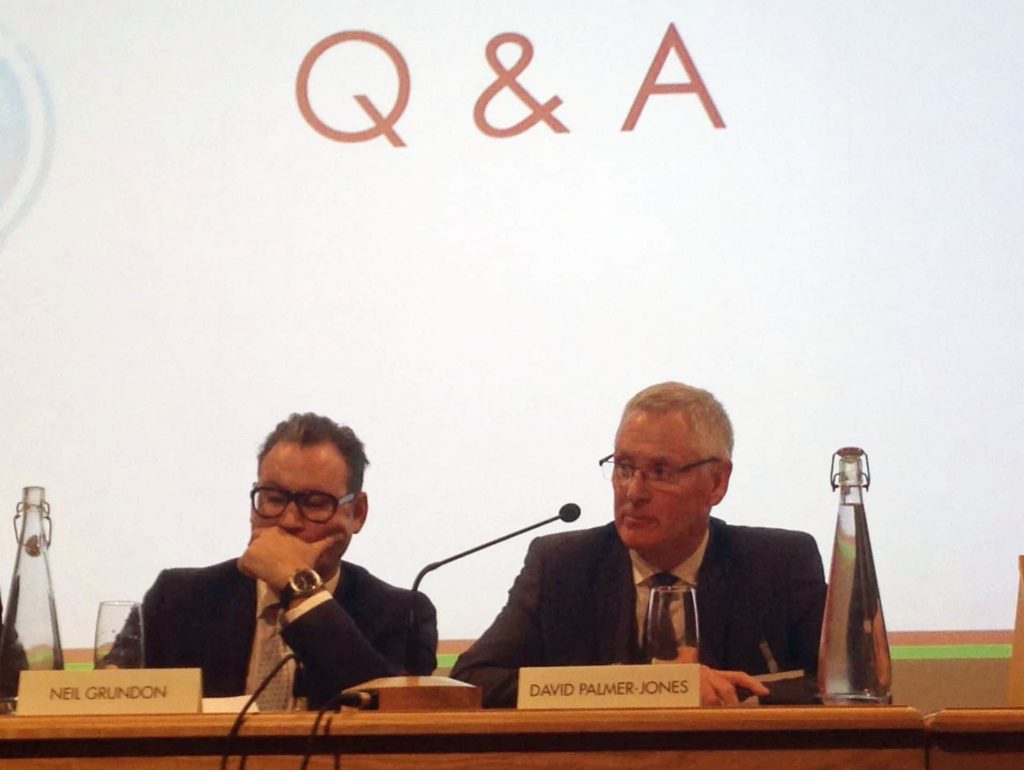
Suez UK chief executive David Palmer-Jones in his capacity as president of the European waste industry trade body FEAD, opened the session putting forward a case for Remain, asking: “What has the EU ever done for us?”

He continued to list several accomplishments, which he claimed would not have been possible if the UK had not been a member of the Union, such as the UK reaching a 44% recycling rate, banishing the title of the ‘dirty man of Europe’ and helping to drive billions of pounds of taxation through landfill tax, as well as the introduction of the waste hierarchy.
He concluded: “In terms of what the EU has done for us, it’s absolutely everything.”
However, Neil Grundon, deputy chairman at Grundon Waste Management, offered a view in favour of the Leave side, arguing that the UK was leading environmental legislation well before the EU existed.
He said: “Whenever you talk to anybody about Europe, they say red tape – that’s what Europe’s all about. And then when you ask for specific examples, everyone says health and safety. Well, I happen to disagree with that.
“We’ve led the world in health and safety, and certainly those of us who work in industry, the one thing that we want to go home every night and feel safe about is that our employees are safe at their workplace.
“I really don’t think that we are going to be any less of a force in our environmental conscience and our environmental pressure on the world as an independent nation.”
Legal Framework
Angus Evers, from the UK Environmental Law Association (UKELA), laid out the legal framework of the possible leave and remain scenarios. Pointing to the existence of a provision for member states leaving the EU, Article 50, Mr Evers explained that should the UK choose to leave, there is a two-year period to try to negotiate the terms of its exit.
He said: “The issue with the Article 50 procedure is that it’s untried and untested. So until we have a withdrawal agreement in place, there’s going to be massive uncertainty. And that is inevitably going to have a chilling effect on investment in the UK.
“If we vote to remain, then it’s arguably business as usual. And for the waste resources industry, the big legislative initiative coming out of Europe is obviously going to be the Circular Economy Package.”
Environment
Steven Tindale, climate and energy policy consultant, opened with the question: “Could the UK protect the environment outside Europe?”
Yes we could, theoretically, he said, but it’s unlikely: “It would be constitutionally possible, but it wouldn’t happen. What would happen is that the UK would go back to being the ‘dirty man of Europe.’
“Outside Europe, there will be no regulatory stability, so that will make investment more expensive in the waste sector, as in other sectors.
“Finally, I think the most worrying thing is the impact on British politics,” he said. “Even worse than the prospect of Boris as prime minister is that the Brexit campaign has – not deliberately – unleashed some pretty nasty forces in British politics and British society, which will be very difficult to put back in the box where they belong.”
Disagreement
The Q&A session quickly fired up the debate. In response to a question regarding a possible drop in GDP due to economic uncertainty, Mr Grundon said: “I’m not an economist, I’m a businessman. I can say, from that perspective, we will not see any changes.”
Mr Tindale countered: “I’m also not an economist, but unlike most brexiteers, I take notice of what economic experts say. And one of the most worrying things about the Brexit campaign is rubbishing of expert opinion.”
Mr Palmer-Jones closed the session with a rallying cry. He said: “Do we need regulation in our industry? We absolutely do. Our big problem is that we divorce ourselves from getting involved in Europe.
“It’s an embarrassment for me to hear that 27 member states are involved in shaping legislation… We’re really good in terms of legislation in the UK – we should get in there and sort out Europe and we can sort out some really good regulations and build upon some of the stuff that’s coming down the line now.”

Register for free to comment