


The decision is a serious blow for WRG's hopes in a county where it has traditionally had a strong presence. And an award would mean that Viridor would have to find £100 million of funding for the plant. Only this week it has raised concerns over higher borrowing costs for capital projects, with interest rates up from 6.5% to 8%, as well as reductions in capital allowances.
Viridor knows the financial challenges well, having also seen a long, drawn -ut process for its contract in Manchester although its status as part of the water-to-waste Pennon Group could help it secure the funds.

Only incineration came forward as financially viable
Keith Mitchell, leader, Oxfordshire county council
Oxfordshire county council's cabinet decided to select Viridor as the preferred bidder to build the energy from waste incinerator in Oxfordshire to dispose of residual waste – waste left after recycling. And, while looking at other technologies, Oxfordshire leader Keith Mitchell, said: “Only incineration came forward as financially viable.”
Viridor's managing director Mike Hellings said: “We are proud to have been chosen by Oxfordshire, one of the country's leading recycling authorities, as their preferred bidder. Our proposals have been designed to provide the council with a safe, robust and cost-effective solution to meet their needs and to complement their already successful recycling and waste prevention initiatives.”
Mr Hellings added: “I would like to congratulate our team and we all look forward to progressing this project, including the planning process further and delivering a first-class treatment facility for the residents of Oxfordshire”.
In a statement announcing the decision made at a meeting of Oxfordshire's cabinet yesterday (September 7), the county went to considerable lengths to reassure residents over the idea of incineration saying that energy recovery was an option adopted by other local authorities, even noting that “there are incinerators in the centres of Paris and Vienna and two on the outskirts of London”.
Ardley
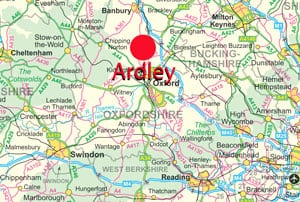
Confirming Virirdor as preferred bidder, the council said: “Viridor, one of the UK's leading recycling, waste management and renewable energy companies, is proposing to build and operate a state-of-the-art energy-from-waste (EfW) facility at its existing landfill and recycling site in Ardley, north Oxfordshire, which will have a capacity to process up to 300,000 tonnes of waste.”
Planning approval for the incinerator at Ardley will be considered by the county council's planning and regulation committee during the autumn. WRG still has an application in for an incinerator at its Sutton Courtenay site in Oxfordshire which will not be needed by the county, assuming Viridor is confirmed as contractor.
A contract to Viridor is scheduled to be awarded in February 2010 for a three-year construction period with waste treatment work starting in 2013. The decision to shortlist WRG and Viridor was made more than a year ago (see letsrecycle.com story).
On recycling, the county council said the county recycled over 43% in 2008 and is set to recycle over 47% in 2009/10 and that councils in Oxfordshire are aiming for at least 55% recycling.

The incinerator is also expected to take in some commercial waste and Oxfordshire could benefit financially from this. The county currently manages 300,000 tonnes of municipal waste per year of which 185,000 tonnes is disposed of to landfill. One of its landfill contracts continues to 2028 and this will take some of the material. Over 90% of residual waste is to be delivered to the plant.
Mortgage
The contract will use similar principles to a Private Finance Initiative contract but PFI credits are not being pursued for it. It will run for 25 years and Oxfordshire explains that it would repay Viridor for the capital cost in “much the same way as a mortgage”. The contract will be structured as a special purpose vehicle to be set up by the contractor to build and operate the facility.
Payment to Viridor would be by a monthly unitary charge which is then adjusted using a formula “set out in the payment mechanism. Adjustments include deductions for performance failures, failure to achieve the contracted diversion rates and non-acceptance of waste. The payment mechanism will also calculate third party income sharing and excess profit share.”


Register for free to comment