


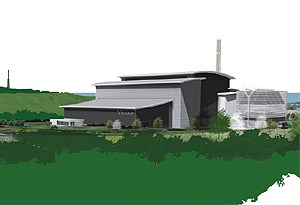
Despite questions from central government over its support for large-scale energy-from-waste incineration, the company is continuing with its plans to develop a 450,000 tonne annual capacity facility.
SEPA – the Scottish Environment Protection Agency – will invite members of the public to comment on Viridor's application for a PPC permit, and once a draft decision has been made will launch a second consultation.
The Agency said communities close to the site of the proposed plant have a clear interest in this matter, and has been given a specific page on SEPA's website to deal with the application and issues surrounding it.
Large incinerators
Scotland's environment secretary Richard Lochhead said in January that his SNP-led administration would reject any “large, inefficient incinerators” proposed to deal with municipal waste (see letsrecycle.com story). However, Mr Lochhead accepted the need for small, localized energy-from-waste facilities, but for no more than 25% of municipal waste in Scotland.
Viridor has since confirmed it is reviewing its proposals for the energy-from-waste facility at Oxwellmains in the light of the national policy announcement.
Although it is proposing a large incinerator, the company argues that since it is to use combined heat and power technology, the facility should not be considered “inefficient”.
Commenting on the environment secretary's announcement, the company said: “The Minister is quite right in supporting efficient EfW facilities with combined heat and power, the type of facility we are proposing at Oxwellmains near Dunbar. Only residual wastes, i.e. wastes from which recyclable materials have been removed, will be treated there using EfW. Our proposals are for an efficient plant with significant renewable power output plus heat available for local community, business, or horticultural users.”
Nevertheless, the company questioned the government's understanding of efficiency within the generation of power from waste, suggesting that the Scottish government could act against the production of some renewable power by requiring certain levels of efficiency.
It said: “We are concerned that Government should understand that there is no definitive level above which EfW plants suddenly become inefficient, particularly when they offer combined heat and power. Certain efficiency levels being debated may rule out the production of renewable power.”
Commercial wastes
We are concerned that Government should understand that there is no definitive level above which EfW plants suddenly become inefficient.
Viridor statement
The company also pointed out that the Scottish Government's 25% cap on energy-from-waste related to municipal waste, and said its incinerator would be used for around 150,000 tonnes commercial and industrial waste a year as well as municipal waste collected from the Edinburgh, Lothians and Scottish Borders area.
The statement from Viridor said: “Viridor provides essential recycling services to business and commerce across Scotland. It believes that EfW can play a central role in the recovery of value from post-recycling industrial and commercial wastes. This will not only support Scottish business in moving towards greater levels of resource efficiency, but also help to offset the significant impact of increasing landfill tax.”
Viridor said its proposed energy-from-waste project would deliver carbon reductions compared to current practice, and would meet the need to deal with “actual and projected future waste arisings”.
The plant is being initially built to house two lines providing 300,000 tonnes per annum capacity, with a third line to be constructed afterwards to meet required demand. Around 25% of the input tonnage would arise as bottom ash – about approximately 137,000 tonnes of material, with Viridor intending to use 25,000 tonnes as landfill cover, to recycle 112,000 tonnes into secondary aggregates leaving the remaining 22,000 tonnes for landfill disposal unless a use can be found for it in the chemicals industry.
Power
Using “moving grate” technology, the facility will produce 38.6MW of energy, of which 34.2 would be sold to the National Grid, from the total 450,000 tonnes capacity. At the 300,000 tonnes level, it would generate 24 MW of power.
Viridor said a “Heat Plan” will be implemented “to ensure the options for use of the residual excess heat are defined and pursued”. The plan suggests that Dunbar has a number of small industries and other facilities which could be potential users, as well as the potential for new housing that could form part of a district heating scheme.
The company concluded: “While we are happy to review our proposals, we remain convinced of the benefits of an EfW combined heat and power facility at Oxwellmains. This will serve as an element of the essential infrastructure necessary for progressive resource management, providing an effective and proven solution to the urgent matter of landfill diversion and avoidance of EU fines.”


Register for free to comment