

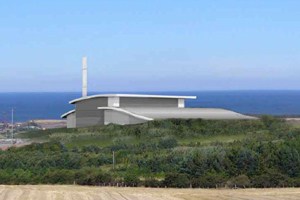
The Scottish government's reluctance to rely on large Energy-from-Waste schemes has contributed to Viridor reducing the capacity of the combined heat and power facility it proposes to build to process municipal waste from the Edinburgh area.
While January's initial planning proposal for the site near to Dunbar envisaged a plant with the capacity to process 450,000 tonnes of waste a year, the amended application, submitted to East Lothian council on Tuesday (May 13), includes a reduced capacity of 300,000 tonnes.

Instead it will be able to process 150,000 tonnes of residual municipal waste, collected from Edinburgh and East and Mid-Lothian councils, and 150,000 tonnes of residual commercial and industrial waste from the surrounding region.
The changes to Viridor's proposals follow a review it launched in February, at the same time as submitting a proposal to the Scottish Environmental Protection Agency for a pollution prevention and control (PPC) permit for the scheme (see letsrecycle.com story)
Its review came after the Scottish government announced in January that it plans to set a 25% cap on the use of Energy-from-Waste facilities to process municipal waste, as it aims to increase the country's recycling rates to 70% by 2025 (see letsrecycle.com story).
The company's external affairs manager, Dan Cooke, acknowledged the impact that the government's stance had had on their decision to amend the plans for the plant, which would be built at its existing Oxwellmains landfill site.
“The reduction in size and capacity allows the facility to reflect local need and the aspirations of the Scottish government,” he said.
“Viridor is committed to working to improve recycling levels and uses a whole range of technologies across the country to recover valuable raw materials from our waste. Even the bottom ash from the EfW facility can be reused as an aggregate in road-building.”
He added: “Viridor will work with local authorities supplying waste to the facility in managing and improving their recycling and collection programmes by reviewing inputs into the plant and feeding back on the best way to ensure all possible recyclates are removed.”
Consultation
The refinements to the company's proposals also follow a public consultation that was launched in August 2007, with Mr Cooke explaining that the reduced size of the plant, as well as its aim to maximise the use of the railways to transport waste, reflected opinions offered during that process.
“The revised proposals also address local views from the public consultation, keen to see a smaller facility that is less reliant on road transport and come following wide public consultation,” he said.
As well as powering the plant, the Oxwellmains facility would produce 22 megawatts of electricity to be sold to the National Grid, reduced from the 34 megawatts that the original, larger-scale proposals envisaged.
Viridor is yet to confirm a market for the heat that the plant could produce, explaining that it “is currently pursuing several potentially viable and deliverable opportunities for CHP schemes through negotiations with interested parties.
“However Viridor cannot expect to have obtained a clear commitment from a future user of the heat output without having secured a planning consent.”
The company expects decisions on both the planning application and PPC permit to be made this November at the earliest, and hopes to have the plant up-and-running by 2012 or 2013.


Register for free to comment