




Packaging is going to continue to be a focus for attention
Adrian Hawkes, Valpak
The company claims that while a rise in targets over the next decade appears unavoidable due to the current tide of political will and desire to protect the environment, there is a need to balance this with the costs to obligated businesses.
Now, the company is advocating a number of modifications to the targets proposed in the government's consultation, which was launched in March and closed in May (see letsrecycle.com story) – with a focus on slightly reducing the plastics, aluminium, steel and wood recycling targets in particular (see table below).
Adrian Hawkes, director of policy at Valpak, told the Futuresource conference and exhibition last month (June 15) that, as they were, these targets – for 2011-20 – appeared “stretching and onerous”.
He said: “These targets really do present a big challenge to the industry and potentially huge costs. We have to look at if that is worthwhile or not.
“The paper and glass proposals look challenging but are potentially achievable. But plastic, steel, aluminium and wood are unlikely to be met without excessive costs. Up to £155 million could be saved a year by 2020 by slightly reducing these targets.”
Mr Hawkes acknowledged that the lower targets would lower the carbon saving by up to 400,000 tonnes, but said that each extra tonne of carbon saved would cost industry £400, commenting: “there are other, better ways of saving carbon than that extra bit of packaging recycling”.
|
|
Paper |
Glass |
Al |
Steel |
Plastic |
Wood |
|
2011 |
69 |
62.9 |
42.8 |
74.8 |
22.8 |
26.7 |
|
2020 |
86.2 |
69 |
69.6 |
56.9 |
56.9 |
70.6 |
| Proposed packaging recycling targets for 2011 and 2020. Source: Defra | ||||||
Plastics
Looking at plastics in more detail, which has proven a particularly controversial area, Mr Hawkes said Valpak advocated a 45-50% recycling rate by 2020 as opposed to the 57% proposed by the government. This is based on detailed data analysis (see table).
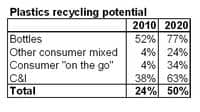
Mr Hawkes said: “That's still a huge step forward from current levels but would significantly reduce costs on industry.”
Mr Hawkes said that if the 57% target were to be achieved, it would require large-scale collection of household mixed rigid plastics and film, with the potential to adversely affect quality and severely increase cost.
He said: “The 2020 targets are more than double the current rate and higher than anywhere else in Europe, based on 2007 data.”
Additional
Presenting some additional points for consideration, Mr Hawkes also said that 10 years was a long time ahead to be setting targets, and called for a target review before 2015, to see how things were going.
He added that steps needed to be taken to reduce the gap between national and business targets which currently stands at about 20%.
Response
The government's response to the packaging consultation is expected some time after the summer and Mr Hawkes said that the indication so far from government was that there was still an appetite to tackle packaging head-on.
He said: “The UK was one of the worst countries for packaging recycling but I don't think that is true any more. We are now getting better than many other European countries. But those negative perceptions do still remain. So packaging is going to continue to be a focus for attention.
“One of the first things that Caroline Spelman noted was that excess packaging is going to be a key issue for the current government. And packaging is a relatively easy legislative target.”
Summarising, Mr Hawkes said that outright rejection of the proposals was unlikely to succeed, but that the proposals may be modified if government was provided with sound data in support of the argument.


Register for free to comment