

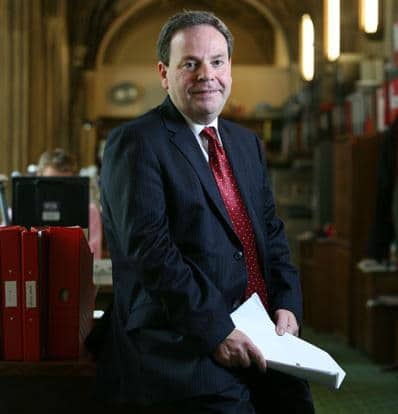
Delivering the keynote address on producer responsibility at the Local Authority Recycling Advisory Committee's (LARAC) annual conference in Liverpool yesterday (October 7), Mr Lucas, who is the MP for Wrexham, claimed the UK was at a “pivotal point” in the evolution of its WEEE system.

I am absolutely committed to encouraging producers and retailers to play a full part in getting the message to the right people
Ian Lucas, minister for business and regulatory reform
While praising the role played by local authorities in helping the UK to significantly exceed the 4kg per head of population collection rate set by the EU WEEE Directive for 2008, he said a further increase was vital to truly “reap the environmental benefits” of the Directive.
Labelling illegal exports and consumer behaviour the “two major challenges” facing the system, Mr Lucas told the event: “We must stamp out the leakage from civic amenity sites and elsewhere that is leading to illegal exports.
“Government will play its part and the Environment Agency have successfully prosecuted many businesses and organisations that have disposed of waste illegally and will continue to do so. But ultimately this can only be stopped by action at the local level,” he added.
He explained that changing consumer behaviour focused on increasing householders' awareness of the fact that small electrical products could be “readily recycled” in the same way as large domestic appliances such as cookers and fridges.
The issue of small WEEE recycling has previously been raised as a particular problem by key figures in the WEEE sector (see letsrecycle.com story) and earlier this year WRAP and Mr Lucas' department, the department for business, innovation and skills (BIS), teamed up to lead an awareness campaign in 12 local authority areas (see letsrecycle.com story).
In his speech, Mr Lucas welcomed the results of that campaign, revealing that in some areas small WEEE recycling rates had increased by 40% year-on-year.
But, he called for more to be done, and particularly stressed the need for producers and retailers to play a role, stating that: “I am absolutely committed to encouraging producers and retailers to play a full part in getting the message to the right people.
“The WEEE Regulations do, after all, adopt the principle of 'producer responsibility' and those obligated by the Regulations must play a full part in engagement with their customers,” he added.
He claimed that, with the “imminent” revised WEEE regulations set to take effect from January 1 2010, producers and compliance schemes would be “operating in closer partnership to ensure the UK WEEE system works to the advantage of all involved”.
And, he stressed that local authorities would “maintain their freedom” to choose which compliance scheme they want to work with to clear WEEE from their sites.
ELVs
Elsewhere in his speech, Mr Lucas hailed the impact of the End of Life Vehicle (ELV) Regulations, and in particular the two networks of authorised treatment facilities (ATFs) set up under the regulations to allow vehicle manufacturers to meet the recycling obligations.
He said: “I know that the high price of scrap metal helpfully coincided with the introduction of producer responsibility, but scrap metal prices have rarely before reached the lows seen at the end of last year, with no discernable increase in abandonment, and so I conclude that the networks must be playing their part.”
Last year, the steep decline in scrap metal prices prompted concerns in the ELV sector that there could be a sharp increase in the volume of abandoned vehicles which, when prices were high, were taken to both licensed and unlicensed vehicle dismantlers (see letsrecycle.com story).
Mr Lucas also praised the networks' “resilience” in dealing with the increased number of vehicles passing through the system as a result of the government's scrappage scheme.
Batteries
In terms of batteries, with BIS taking the lead in relation to automotive and industrial waste batteries, Mr Lucas said he was “confident that traditionally high collection and recycling rates there will not be disturbed”.
Describing the system in place for automotive and industrial batteries as a “safety net”, he explained that it would give councils and others the right to obtain free collection by producers if they require.
“In other words, if civic amenity site operators are unable to receive payment for any car batteries deposited there by residents, then the removal of those batteries will be free of charge, and no cost incurred,” he added.
He also claimed that he believed the producer responsibility system for portable batteries was “fit for the purpose”, and explained that, with its similarities to the WEEE system, BIS would be watching how it ran “with great interest”.
Experiences
Mr Lucas claimed that the UK's experiences with producer responsibility for WEEE, ELVs, tyres, packaging and batteries had helped him to conclude that it could be a “useful tool” for “internalising the cost externalities of waste”, as well as increasing both environmental protection and recycling rates.
He also stressed that a “one-size-fits-all” approach would not work, noting that “we do not think that it is appropriate to establish a rigid producer responsibility template”.
And, he claimed that a “genuinely market-based approach” was generally the best approach to producing responsibility, explaining that he believed it would benefit business, consumers and the environment.

Register for free to comment