

This was among the findings of a survey carried out by the Agency to assess whether local authorities are meeting their requirements under the Waste (England and Wales) Regulations 2011.

The Regulations, which came into effect for businesses and councils from 1 January 2015, stipulate that materials such as paper, metal, plastic and glass must be collected separately if it is necessary to encourage high quality of the recycling of the material.
Councils may continue to collect the materials in a single ‘commingled’ stream, if it is possible to demonstrate that separate collections are not technically, environmentally or economically practicable (TEEP).
Results from the survey, which began in April 2015 and involved participation from 283 of the country’s 321 collection authorities, were published yesterday (21 January).
According to the Agency the majority of councils have performed some sort of assessment to establish their compliance with the law – and only eight have resulted in any form of service change by the local authority.
Commingling
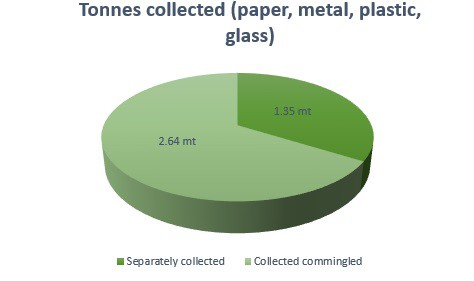
And, more revealingly, the survey also suggests the vast majority of the recyclable materials collected by councils at the kerbside – 2.6 million out of a total 3.9 million tonnes – is collected commingled. This commingling does include collections where some materials, such as paper, are collected separately.
This is despite fears in the build up to the start of the regulations that councils might have to move away from commingling to comply with the law.
 The spectre of a legal challenge from environmental activists to force the introduction of a separate collection regime has also loomed large over local authorities, but despite threats from pressure group UK Recyclate to Ealing council over a potential action in summer 2015 (see letsrecycle.com story), this pressure has not been taken any further.
The Environment Agency has in the past expressed little desire to pursue local authorities on TEEP, unless there is a clear risk of non-compliance.
Compliance
In its survey document, the Agency noted: “Overall from the survey results we found that most WCAs [waste collection authorities] in England had completed necessity and TEEP assessments or planned to do so by the end of 2015.”
It added: “Assessment outcomes mainly find that no change is needed in the type of arrangements to collect the 4 [sic] waste types. A small number of WCAs have made changes to collection methods as a result of their assessments.
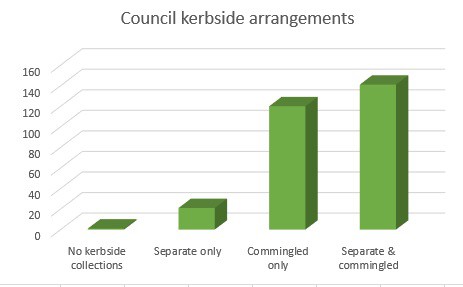 “Kerbside co-mingled [sic] collections of these wastes are the main collection method in England and are likely to remain so.”
Of the 2.6 million tonnes of commingled material collected at the kerbside, the Agency notes that this is primarily a mix of all four (paper, glass, metal and plastic) types of recyclable or less commonly two or three materials mixed together. “Co-mingling [sic] at the kerbside represents 65% of the total WCA collections (by all collection methods) of these 4 wastes,” the Agency adds.
The data also indicates that of the four waste types, paper is separately collected in the highest quantity and by the greatest number of collection authorities (226), whilst plastic collections has the lowest number of authorities making separate collections (119). This includes collections via the kerbside, HWRCs and on-street bins.
On glass, the report notes that the material was collected by all the authorities polled with 39% making separate collections only. 25% make only commingled collections of glass whilst the remainder (36%) collect glass both separately and commingled.

The report adds that glass is least likely out of the four materials to be collected at the kerbside. Whilst nearly 90% do collect glass at the kerbside there are 29 authoritiess that collect glass only by other collection methods.
Assessments
Over 90% (196) of the authorities polled by the Agency revealed that they had carried out assessments on their compliance with TEEP, while a further 65 had expressed a desire to do so after having been asked.
Some 22 councils revealed that they had no plans to carry out a TEEP assessment – however, analysis revealed that most of these have no element of commingling in their collection service. Four local authorities were found to collect less than 80% of their waste separately, but had no plans to assess their TEEP compliance. These will be under further scrutiny, the Agency revealed.

Register for free to comment