

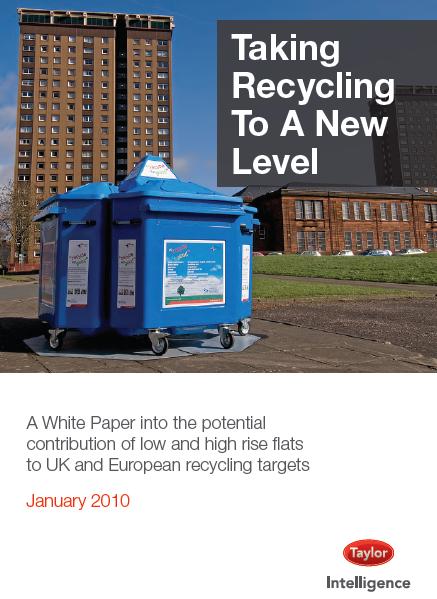

The council introduced 205 near-entrance recycling node ‘centres' produced by Taylor outside the properties in April 2009, as well as containers for glass waste. Residents were also provided with a box to store materials inside their flats until they were ready to take the material to a recycling point.
The study, which was carried out under the direction of Professor James Baird of the Caledonian Research Centre at Glasgow Caledonian University, found that the service increased the quantity of recyclables collected from virtually zero to eight tonnes a week.
It also boosted the council's overall recycling rate by 0.3%, included a “hard-to-reach” group in the council's recycling efforts, and received high levels of household satisfaction with 93% of residents recycling more, and 98% saying they were happy with them.
And, with around 20% of UK households being either high-rise flats or multi-occupancy dwellings, Dr David Gillett, business development director for Taylor Intelligence, told letsrecycle.com that the report's findings were relevant to all urban areas.
“It's particularly appropriate for London and particularly appropriate for LWaRB and the House and Communities Agency because if you look the reduced public spending world, there still a lot of money going to be spent on building multiple occupancy housing,” he said.
Formula
While acknowledging that there was no one-size-fits-all solution for introducing a successful recycling service for flats, Dr Gillett explained that “in North Lanarkshire they have found a formula that works”.
“Infrastructure, a communications campaign, it's very important to have a consistent message and they seem to have done it very effectively, also aesthetics of the containers used – these things combined have achieved a record rate,” he said.
Dr Gillett explained that, alongside adding food waste collections, introducing recycling for flats represented the next step for councils looking to add to their recycling rates, noting that “we have done the easy stuff and the next thing's much harder”.
And, he claimed that it could add as much as 1% or 2% to a local authority's recycling performance.
Cost
The report also outlines how a service can then be made more cost-effective, including collecting recyclables from the collection nodes fortnightly rather than weekly and providing more of the bins.
In the case of North Lanarkshire, it claimed this could bring the cost per tonne of recycling down from £183 per tonne to £106 per tonne, with the cost of the service to the council also reduced as landfill tax increased.
The trials in North Lanarkshire follow the success of a similar service being rolled out in South Lanarkshire in January 2008 (see letsrecycle.com story).


Register for free to comment