


The survey was conducted for the waste management company by research group YouGov and asked recycling questions of more than 2,000 adults in England, Scotland and Wales.
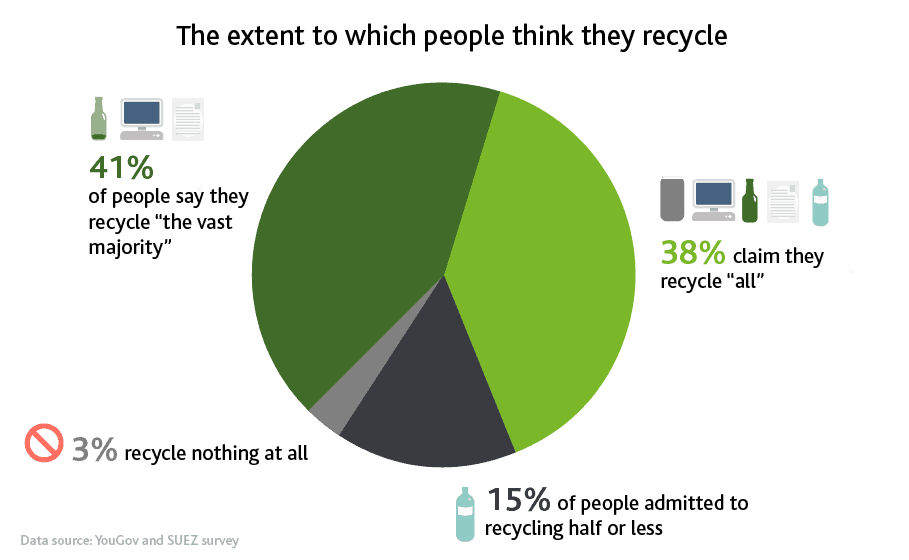
YouGov found that 38% of the population claim they recycle all the household waste they know can be recycled, while a further 41% of people believe they recycle the ‘vast majority’.
Furthermore, when asked what stops them recycling more than they currently do, nearly half (44%) said ‘nothing in particular’ is stopping them. Only 15% of people admitted to recycling half or less of everything they could, and 3% recycled nothing at all.
The findings also reveal that across the British public, those aged 45+ tend to think they recycle more compared to the younger generation.
Among 45 to 54 year-olds, 41% claim they recycle all they can, which raises to 53% for those aged 55 and over, but the number falls as low as 15% for 18 to 24 year-olds.
‘Disconnect’
However, households in England throw out over 27 million tonnes of refuse a year, of which around 45% is recycled — a figure that casts doubt over these household recycling claims, according to Suez. By comparison, Wales’ household recycling rate, at 56.2%, is the leader among the home nations.
While England is the most populous country within the United Kingdom and as such has the biggest impact on recycling, rates began to plateau in 2012/13 and actually fell by 0.7% to 44.3% for the 12 months to June 2015, according to Defra figures.
Plateau
Chief executive of Suez recycling and recovery UK, David Palmer-Jones, said: “Recycling performance in the UK has come on leaps and bounds over the last decade and it’s heartening to see that there is still so much enthusiasm for it among the British public.
“The national recycling figures confirm that actual recycling performance has plateaued at around 45 per cent of all household waste thrown away over the last few years – which could be explained by some of the findings of the Suez/YouGov survey which point to a disconnect between how much people think they are recycling and what they are really throwing away.
“If, in total, nearly eight out of ten people think they are already recycling all, or at least the majority, of everything that can be recycled, then that may explain why many don’t see the need for further improvement.
Standardised
The findings revealed that 50% of the British public would support products having standardised packaging made from materials that can be widely recycled.
When asked how effective certain initiatives might be for reducing product packaging waste from major manufacturers and retailers, 57% thought a legal requirement to publish how much packaging they produce would be effective; 72% thought providing more on-pack recycling information and 69% said paying more tax on their packaging based on how much they produce would be effective ways of reducing waste from product packaging.
Nearly half of the respondents (49%) also backed the idea of council tax reductions for households that recycle more and reduce their general waste, while 42% supported the idea of reward vouchers to spend in local shops.
Performance
Commenting on ways to drive performance, Mr Palmer-Jones said “Perhaps it’s time to engage the public in more active ways.”
He added: “The findings of our research also show we all have more to do to engage the younger members of society and help them to become better and more enthusiastic recyclers, whilst also making existing collection schemes as easy to follow as possible.
“As an industry, working in partnership with manufacturers, retailers and local authorities, it is clear that we can all do more to inform the public about the materials in the products and packaging they consume, how they can be recycled and, importantly, what happens to them after are they are put into the bin.”


Register for free to comment