


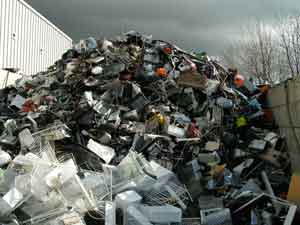
The percentage of household waste electrical and electronic equipment collected for recycling or reuse in the UK increased from 36.66% in 2009 to 38.4% in 2010, figures published by the Environment Agency yesterday (February 28) have revealed.
The data for quarter four of 2010 also shows a small increase in the tonnage of material collected for recycling or reuse, up by 3.34% from 446,301.27 tonnes in 2009 to 461220.232 tonnes in 2010, or 7.46 kilograms per head of population.
 This means that, based on a population of just over 61 million, the UK again comfortably exceeded the EUs current weight-based waste electrical and electronic equipment (WEEE) collection targets which require four kilograms per head of population to be collected.
It comes despite the amount of electrical equipment placed on the market again falling, by 1.6% from 1,220,347.88 tonnes in 2009 to 1,200,486.738 tonnes in 2010.
But, with European WEEE targets moving to a percentage-based goal under the ongoing recast of the EU WEEE Directive, the slowdown in percentage increase between 2009 and 2010, compared to an increase from 30.66% to 36.66% between 2008 and 2009 is likely to be of some concern.
In particular, if the European Commission proposals for a 65% target for 2016, calculated as a proportion of the amount of electrical equipment put on the market (see letsrecycle.com story) are introduced, the UK will need to significantly speed up the rate in increase.
There is, however, some uncertainty over just how taxing the percentage-based goals will be, with the European Parliament last month backing an apparently easier-to-achieve target for 85% of all WEEE generated to be collected (see letsrecycle.com story).
Non-household
The figures published yesterday also reveal a continued relatively poor performance in terms of the percentage of non-household, or business-to-business (B2B) WEEE collected.
Just 5.14%, or 15,896.133 tonnes, of the 309,450.299 tonnes of non-household electrical equipment put on the market was collected for recycling last year.
This represents a slight increase from the 4.89% collected in 2009, but is likely to do little to assuage concerns over there being a large amount of B2B WEEE handled outside the official system and, as a result, potentially ending up being illegally exported to the developing world (see letsrecycle.com story).
WEEE categories
In terms of specific categories of household WEEE, the figures for small WEEE which has been identified as a key priority if the UK is to significantly increase its collection rate show a slight increase in percentage and tonnage collection rate.
In 2010, 22,870.284 tonnes, or 16.14% of category 2 small household appliances were collected, up from 20,537.52 tonnes, or 14.32% in 2009. This does, however, represent less of an increase than the improvement between the 11.89% for 2008 and the 2009 figure.
Related links
The bulk of the WEEE tonnage continues to come from category one, large household appliances, with 461,220.232 tonnes or 29.66% – of the 476,167.81 tonnes of this category of WEEE collected for recycling or reuse.
The figures published yesterday give preliminary figures for 2010 final figures are set to be published on March 31, when producer compliance schemes will find out the final figures for the amount of WEEE they will have to have collected for 2010 to meet their members obligations.


Register for free to comment