

The facility at Rainham contains a MRF as well as the mechanical biological treatment (MBT) facility, which uses Italian technology to process 180,000 tonnes a year of waste left over once kerbside recycling has been carried out.
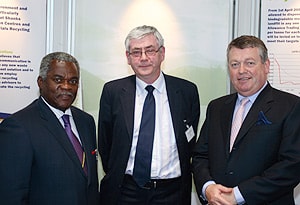
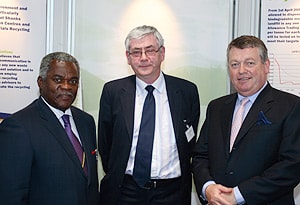 Opening: (left to right) ELWA chair Cllr Milton McKenzie with Defra's John Burns and Shanks chief executive Michael Averill at the opening of the Frog Island plant |
The MBT plant produces a dry fuel material, rather than sending waste straight to landfill.
Defra's Waste Implementation Team programme director John Burns praised the facility, which includes one of the UK's first large-scale MBT plants, as an innovative solution to waste management pressures.
Mr Burns said: “We are delighted to see what Shanks East London is doing here with MBT and recycling, offering a waste management facility and the opportunity to replace fossil fuels.
“Increasingly, sustainable waste management groups are being recognised for their renewable energy and carbon reduction work. They demonstrate that there are opportunities for innovative and dynamic companies,” he said.
Shanks chief executive Michael Averill said at today's opening: “This is a facility that is well ahead of its time and we are fiercely proud of it. It delivers on every level: the carbon agenda, Landfill Directive, national recycling targets, and the ELWA waste strategy.”
Defra
Mr Burns was careful not to insist that local authorities invest in MBT, but told letsrecycle.com: “We support MBT as being a very valid route for a local authority to take, but it is up to local authorities to decide what is the most suitable technology for their needs. MBT is an important part of achieving both recycling and landfill reduction targets, but the waste hierarchy is incredibly important as well.”
He acknowledged that some companies might be reluctant to invest in new technologies without a suitable framework, but promised: “The government’s revised waste strategy will offer crucial guidance on how we see future targets being achieved”.
ELWA
The Frog Island plant is a key part of Shanks’s 25-year contract to deal with the household waste of the East London Waste Authority, which represents the London boroughs of Newham, Havering, Redbridge and Barking & Dagenham.
The ELWA contract serves 800,000 local residents and recycled 14% in 2005/06. Shanks has the target of recycling 33% and diverting from landfill 67% of the area’s waste by 2016.
The Frog Island facility will soon be joined by another plant of the same capacity at neighbouring Jenkins Lane, which began taking in trial levels of waste on Monday (April 16).
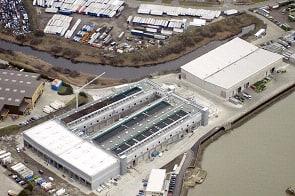 The Frog Island facility will process 180,000 tonnes of “black bag” waste each year |
Technology
The Shanks MBT process uses the Italian Sistema Ecodeco system. This sees waste bags shredded and dried in indoor windrows for 14 days. As they degrade, air is drawn through the waste. This process kills pathogens, stabilises the waste and reduces its weight by 30% in water loss.
It is then easier to extract metals, glass, and large pieces of plastic that householders did not separate out, for processing at Shanks’s MRF. Very fine material is filtered out for a compostable material. This is currently landfilled, but Shanks is working on a contract to use it as restoration material for road construction.
Remaining large pieces such as nappies are sent to landfill. This leaves a substantial amount of material to be used as solid recovered fuel (SRF). One tonne of raw municipal waste produces half a tonne of SRF, which has about 80% of the calorific value of coal.
All the SRF Shanks makes is currently supplied to cement kilns. Shanks pays the cement companies for this, but for a figure less than that of landfill, it said.
Mr Averill told letsrecycle.com that there was great demand for such fuel from cement kilns, making SRF an environmentally friendly alternative to fossil fuels. “It is a direct and immediate fossil fuel substitute,” he said. SRF was also more efficient than burning raw waste, he added, because energy is used up driving off moisture, and the raw waste contains recyclables that do not burn.
Energy security
Mr Averill said that environmental concerns were not the only factor driving demand for SRF.
| Related links: |
“This is more and more a cost issue. When the Russians turn the gas tap off to the Ukraine, people talk about security of supply. Security of supply here is very attractive to our cement customers. Because of the long term nature of our contract with ELWA, we can fix the energy cost for our cement customers.”
But Mr Averill said Shanks had not yet made an arrangement to supply the SRF to neighbouring firm Novera Energy’s gasification plant (see letsrecycle.com story). He said: “Novera has planning permission and is adjacent to our site, so it makes a certain amount of sense. Novera are evaluating all our costs to make us a competitive proposal. If they give us the right terms for the period we’d be happy to do business with them.”


Register for free to comment