



The lessons from the recent past are that the two waste parties, local authorities and the private sector, should have a better contractual relationship
Ian Goodfellow, Shanks
Speaking to letsrecycle.com, Mr Goodfellow outlined his thinking on a range of local authority-related issues including technology, recycling and PFI.
Prompted in part by comments on energy from waste by waste expert Peter Jones earlier this year, Mr Goodfellow emphasised that recycling had a big part to play in terms of a route for household waste and that energy too did have a role.
He said: “I feel Peter has a point, energy has a role to play, a role to play after you have maximised the opportunities for recycling.”
Mr Goodfellow continued: “For local authorities recycling is affordable and a way of getting environmental issues in front of the public.”
And, he said that commingled collection was cost-effective, although it needed “constant communication to help mitigate inevitable contamination at the back door. Markets exist for the commingled material and the equipments exists for sorting.”
But, he considered partnership as important, taking note of the downturn in the recycling markets. “The lessons from the recent past are that the two waste parties, local authorities and the private sector, should have a better contractual relationship. Risks and rewards should be shared and still are too much with the private sector.”
In terms of “UK plc” Mr Goodfellow said: “We are now at about 34% and there is 10-15% more recycling to be had. This recycling needs to be economic and sustainable and it can be. Then you enter into the energy debate and the economics of incineration. At a scale of less than 50,000 tonnes per annum, I am not convinced these are affordable – North Lincolnshire works and is one of the smaller plants, at 65,000 tonnes.”
Wheelabrator
While Shanks does have strong interests in mechanical biological treatment through its EcoDeco facilities in Scotland and London, the company is also now partnering the US firm Wheelabrator for the development of energy from waste incinerators.
Mr Goodfellow said that he accepted that in the next generation of PFI, EfW was high on the list but said that he believed there was still a role for MBT even if recently some authorities, such as Norfolk, had moved away from MBT to incineration.
He declared: “Some calls for tender say EfW but where we believe the client is technology neutral we will offer MBT on its own or as a solution with EFW.”
Turning back to the views of Peter Jones, he said: “What you might have – moving in part to Peter's position – is moving to the next level of treatment with AD and MBT. Anaerobic digestion has the potential to provide small bespoke facilities but needs bespoke inputs (food and organics) to generate small amounts of power. It is part of the solution and is particularly appropriate in rural areas.
“The other intermediate technology is MBT. This offers a reduction in volume, the production of fuel for large regional users such as cement kilns and in industry. It suits urban areas very well where the nature of properties means it is harder to provide sorting such as in flats and tenements and the inner city.”
Mr Goodfellow added that he felt that it was not a “case of either or. You could see MBT and AD being operated cheek by jowl with the MBT plant serving a remote incinerator which is serving a number of MBT facilities.”
And, MBT plants also have the advantage of producing an organic fraction and materials for recycling, he notes: “Typically this will mean that circa 80% of the waste stream does not go to landfill. MBT outputs are generally 30% moisture, 35% SRF, 2.5% Ferrous, 0.5% non ferrous, 6% glass/aggregate, 8% organics.”
Targets
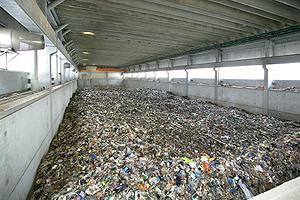
He said: “We are meeting and exceeding our targets for ELWA. In 2009/10 we will exceed our contractual target but at 22% recycling we are out of step with current thinking, as 50% is now the preferred target for PFI projects.”
Looking back in more detail, he said that the success of the ELWA project “demonstrates the value in long-term contracts. But they have to be structured in such a way as to meet the changing needs of contractors and clients. In 98 East London was the next generation type of contact and the bogeyman was an incinerator. Mass burn was then the order of the day, with 30% coming out as ash.
“We opted for MBT to reduce tonnages to landfill but not by using incineration. The
ELWA contract has flexibility in it and looking ahead the issue for the parties will be the economic consequences of change.”
AD is now high on Shanks' radar, especially as it now owns the Dutch anaerobic digestion company Orgaworld. “Orgaworld,” said Mr Goodfellow, “has a proven track record in operating AD plants. We know the technology, the operating risks and the financials.”
The company is committed to the separate collection of food waste to keep it out of landfill, he said. “We are getting to the point where UK is at 34% so the next step is that organic fraction. The next best solution is composting via AD which sits along side MBT as a treatment option for MBT residues and or as a treatment option for separated waste streams. We can generate power and a compost-like product. The key to the AD facility is the quality of input – it is not suitable for black bag waste but needs separately collected kitchen waste. Crucial to this is the emergence of the ability to collect kitchen waste.”
This links Shanks as a waste management company in to the energy market where, Mr Goodfellow pointed out, the company already operates. “We are already there. We provide SRF as a fuel but we need more recognition under the scheme for Renewable Obligation Certificates.
“I would very much like for the Department of Energy and Climate Change to look at the rules for biomass to allow us SRF (solid recovered fuel) access to biomass because, as the rules stand at the moment, we lose potential ROC revenue. In the case of SRF, it has been through a robust measureable process and we consider it is no longer a waste, a discussion we are having with Defra and DECC. If it was not a waste we could cofire existing power stations as these do not have to be compliant with WID.”


Register for free to comment