


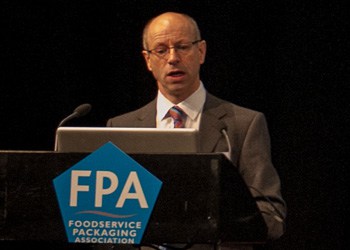
The comments came at the Foodservice Packaging Associations annual environment seminar which took place in Nottingham last week (January 16).

During a session on the key issues impacting on suppliers and users of foodservice packaging, the compliance schemes policy director Mr Hawkes gave an overview of the packaging waste recovery note (PRN) system. In his presentation he highlighted the challenges the sector faced in meeting the targets for some materials, in particular glass and plastics.
The targets for plastics will be subject to a steep increase up to 2017, with the target rising from 42% for 2014 to 57% in 2017.The industry has previously raised concerns about the target with Recoup saying that plastic recycling must double if the UK is to be compliant (see letsrecycle.com story).
Discussing the plastics target, Mr Hawkes said: On plastic we can see there is a really very significant increase on the way in the plastic target that is required from around 30% to over 50% by 2017. This is a very steep increase indeed…the questions that many people are asking is how feasible is that?
Mr Hawkes said he did not have an answer to this question but said that increases of this sort had been seen in other areas in the past, such as in plastic bottles. If we look at plastic bottles, particularly over the last 10 years and how rapidly that has increased. We are now collecting and recycling just over 50% of plastic bottles in the UK.
Plastics
Valpak has undertaken work with WRAP called PlasFlow to investigate scenarios for annual growth as well as the feasibility of meeting this target. Summing up the findings so far Mr Hawkes said: The three main areas that have to increase are plastic bottles, other types of rigid plastics so pots, tubs and trays from the household sector but also from the commercial and food service sectors. Lastly there is commercial stretch film to tap into. So with those we would get there but it is not going to be easy.
The total amount of plastic needed to meet the 2017 recycling targets is 1,200,000 tonnes an additional 550,000 tonnes compared to what is collected at present. He said plastic can be broken into separate markets, each of which has different characteristics and issues.
The project estimates that the UK would need to recycle 305,000 tonnes of post-consumer pots, tubs and trays in 2017 to help meet the target an increase of 200,000 tonnes from 2011 levels. At present, according to Mr Hawkes, these have relatively low levels of collection but there is strong consumer interest and growth.
Considerable growth is also needed in areas including non-consumer film which must increase from the 162,000 tonnes recycled in 2011 to 322,000 tonnes in 2017. While 306,000 tonnes of plastic bottles were recycled in 2011, the PlasFlow project estimates that this will need to increase to 438,000 tonnes to help meet the target.
Costs
Martin Kersh, chief operating officer at the FPA, questioned Mr Hawkes over the consequences of not meeting the targets and the costs involved for businesses to comply.
In response, Mr Hawkes said that the consequences could vary from warnings to fines however he did not know what would happen if all compliance schemes failed. However he remained confident that Valpak has plans in place to help its clients fulfil their obligations.
On the cost side he said: In terms of costs it certainly isnt going to get any cheaper but because of the way the targets have gradually increase, even though it is a high end point, having the ability to plan ahead really helps to stabilise the costs.
Litter
The FPAs event also featured a litter debate which saw members of the foodservice packaging industry give their opinions on how to tackle the issue of litter. They included representatives from: the Industry Council for Research on Packaging and the Environment (INCPEN); Maidstone borough council; Mcdonalds; Keep Britain Tidy and AmeyCespa.
While there were mixed views on whether it was feasible to become a zero litter society and if so, by when, the key messages from the session included the importance of behavioural change and effective communications with no green wash.

Register for free to comment