


The report entitled Investigating the Impact of Recycling Incentive Schemes was commissioned by services company Serco to Eunomia Research & Consultancy in a bid to explore the effects of incentives and reward schemes on recycling rates across 30 boroughs in the UK. Recycling incentives fall broadly into two categories rewards and charges. Both of these are considered in the report. Serco said it is the first time that the performance of recycling incentives has been examined by industry professionals.

The Department for Environment, Food and Rural Affairs (Defra) last month published a report on reward schemes which said that they “cannot be seen as a quick fix” (see letsrecycle.com story).
Broadly speaking, Eunomia said authorities with recycling incentive schemes recorded an average increase of 8% in recycling performance which was accompanied by a 3% reduction in waste to landfill. However the performance was variable.
Schemes analysed as part of the study included: Local Green Points in the London borough of Bexley; Recyclebank schemes in Lambeth, the Royal borough of Windsor and Maidenhead, Wokingham, and Halton; and, Caerphilly county borough council.
Impact
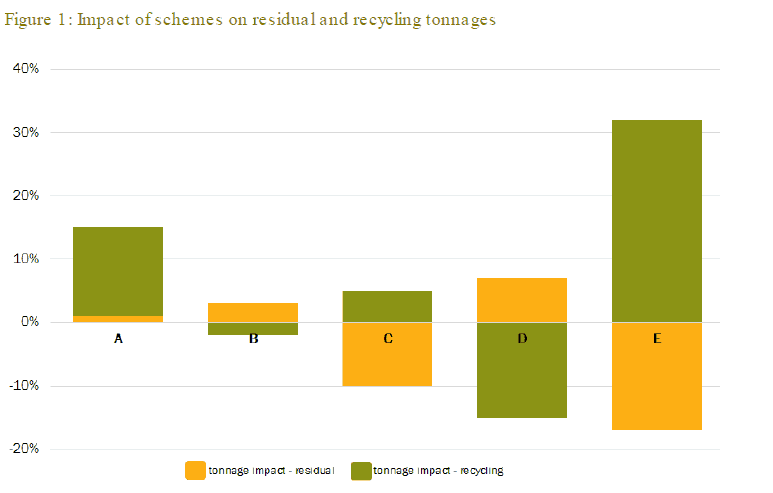
As part of the study, the consultancy looked at the likely impact reward schemes would have on landfill diversion and recycling tonnages, however it notes that the dataset for this is limited. As such, only the tonnage performance of five local authorities has been considered. The tonnage impact was calculated by looking at the percentage changes between the material tonnages collected both before and after the reward scheme was introduced
The results show that three of the five councils saw an increase in the amount of residual waste collected after the schemes were introduced, as opposed to the increase they were hoping for. Eunomia noted that the increases were relatively low at 1%, 3% and 7% in the year following the introduction of the reward scheme. In the two areas where a decrease in residual waste was seen, the changes were more significant with a reduction of 10% and 17%.
It added that there was a positive impact on recycling tonnages in three of the five authorities following the introduction of the reward scheme but again the picture is mixed and two authorities saw a decrease in recycling tonnages following the schemes introduction. Eunomia described the decline for one of these authorities as fairly significant.
Value for money
Value for money was also analysed by Eunomia which divided the schemes into price categories: cheap (<1 / household / year); moderate (1-2 / household / year); and, expensive (>2 / household / year). There was no available data for authorities with the cheapest schemes but the report noted that the cost case is still weaker for the higher cost category. Medium cost schemes, according to Eunomia, come closest to being justified and recouped in diversion savings and recycling income.
On value for money, the report conclude: Value for money is unproven although some of the cheaper schemes are closer to offering cost benefits through reduced disposal costs and increased material revenues. Furthermore, most schemes appeal, from the incomplete data available to use, to cost more to operate than the evaluated benefits they deliver.
As part of the study residents were surveyed. One question which was put to them was are there other ways to achieve a more significant impact? 42% and 41% of those questioned said the roll out of commingled recycled and wheeled bins, respectively, where they didnt already exist would have a significant impact. Meanwhile only 5% believed that incentives would make a difference. However Eunomia said the survey responses should be treated with caution.
Bexley
The London borough of Bexley rolled out an incentive scheme organised by Local Green Points in October 2011 to reward residents on a community basis for waste reduction and recycling.
Related Links
In response to Sercos report, Stephen Didsbury, head of Bexleys waste and recycling services, said he was pleased to see the debate nationally on waste and recycling incentives start to focus on what makes a successful scheme.
Local Green Points managing director, Graham Simmonds, adds: Changing household behaviour is not easy to achieve, offering incentives to drive behaviour change is still a new activity for councils and like anything in life, it aint what you do – its the way that you do it! The Eunomia/Serco research provides some great insight for local authorities, and in our experience there are 4 key factors to a quality scheme reliable data, motivating rewards, effective communications, and smart technology.


Register for free to comment