



It found that three-quarters (74%) of municipal solid waste (MSW) in Wales could potentially be separated for recycling or composting. This suggests that the WAG's ambitious target to recycle and compost 70% of municipal waste by 2050, as outlined in its recent ‘Towards Zero Waste' strategy (see letsrecycle.com story), is achievable.
In addition, the research found that food waste represented about a third (30%) by weight of residual household waste collected – followed by 17.6% paper & card and 9.9% of ‘other combustible materials' such as wood.
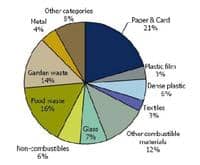
The document states: “The information derived from this work on the composition of each waste stream, together with an analysis of the overall composition of MSW in Wales, will provide local authorities in Wales with sufficiently robust information to enable them to further develop their recycling and composting strategies.”
Other key findings include:
- Residual waste arising at household waste recycling centre (HWRC) sites contained about 35% of the 'other combustible materials' category. This category includes wood;
- The main components of trade waste collected by local authorities were paper & card and food waste. There were differences in the composition of waste produced by different types of business; for example, the proportion of food waste was highest in waste from cafes/restaurants and care homes, and the proportion of cardboard was highest in waste from retail premises;
- The main components of bulky household waste were furniture and white goods; and
- The main components of waste from schools were paper & card and food waste.
The study states: “Local authorities will need to target the residual household waste stream, the residual household waste recycling centre stream and trade waste stream if they wish to maximise the amount of material collected for recycling.”


Register for free to comment