

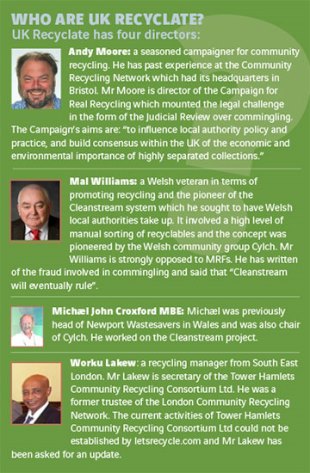
Andy Moore, director of UK Recyclate Ltd and who heads up the Campaign or CRR, has written to a number of local authorities in the Home Counties and the south west of England, who are in the tender process and may have, or be considering, a commingled approach to recycling collections.
It was UK Recyclate, which with other companies, lead the Judicial Review case against MRFs. In a strongly worded letter, seen by letsrecycle.com, Mr Moore writes of the Judicial Review and warns that councils who opt for commingled collection might be challenged in court.
He writes: “I can well understand that [X council] may not relish a starring part in such a case and the national attention it would bring. If so, I would urge you if at all possible to defer and reconsider this decision to adopt a commingled approach to recycling collection.”
Webinar
And, separately last week (see letsrecycle.com story), Peter Jones, a consultant at Eunomia and who has been working with WRAP and the Waste Network Chairs, warned of the risk of a legal challenge from two possible sources.
Giving advice to councils on the Route Map in a webinar organised by WRAP and the Waste Network Chairs, he said: “The risks are around possibility of a legal challenge, either from reprocessors who, through the Judicial Review, have already shown that they are keen to increase the amount of material separately collected or from local environmental groups.”
Challenge
The potential for a challenge has prompted reactions from across the waste sector, including from the Environmental Services Association, LARAC and the Resource Association.
David Palmer-Jones, chair of the Environmental Services Association, said that attention would be better focused on ways to combat flatlining recycling; LARAC, the Local Authority Recycling Advisory Committee, expressed its concern at the news that reprocessors might make a challenge.
Reprocessors
Now, aluminium, paper and other reprocessors-through their trade association the Resource Association -have confirmed to letsrecycle.com that they are not contemplating any legal action.
Speaking to letsrecycle.com, Ray Georgeson, chief executive of the Resource Association, said: “We have made it clear that the Resource Association is not or will not be considering any legal challenge. The Board has said that all the way through. There is no appetite for any legal challenge.”
(Paper mills and aluminium reprocessor Novelis are among the members of the Resource Association and while they are separately still listed as members of the Campaign for Real Recycling, it is understood that the CRR’s website membership list is out of date).
LARAC
LARAC said that having been a key member of the group that produced the recent Route Map for local authorities, it is keen to see the waste industry work together to ensure local authorities have robust evidence to support their decision on collection systems.
LARAC believes the talk of challenges is at best unhelpful and worst divisive, meaning local authorities could be forced to waste valuable time and resources on defending challenges instead of providing services to local residents.
Andrew Bird, LARAC chair, also acknowledged that he was aware of a letter which has been sent to a number of local authorities, warning of the possibility of legal action on behalf of UK Recyclate, but said that he was not aware of any wider support for such measures from within the reprocessing sector.
Mr Bird added that LARAC had anticipated the likely threat of legal action, but said that he was surprised that this had been made public before the Environment Agency had agreed how it is likely to enforce the requirements of the Waste Regulations. It is understood that the Agency and Defra are currently agreeing on a position in this regard.
UK Recyclate Ltd
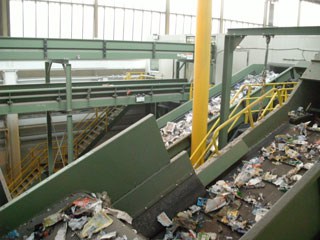
The opposition to commingling now seems to remain mainly in South Wales and Bristol through UK Recyclate Ltd. The company has four directors and is linked with the Cleanstream concept which was developed in South Wales and championed by Mal Williams.
In the past this was supported by Mr Moore when he ran the Community Recycling Network organisation out of Bristol. In 2002, (see letsrecycle.com story) he said: “The trend in kerbside collections as practised by CRN members is taking the UK away from large MRFs as a solution.
“The dinosaur-sized MRFs which take mixed domestic recyclables are currently heading for extinction. Many large MRFs end up consigning large percentages of perfectly recyclable material to landfill. This is due largely to the poor quality of input material and unrealistic expectations about how such material can be sorted mechanically or by hand at speed.”
“Community sector MRFs, dealing with specific parts of the waste stream sorted by the householder, achieve average reject rates of 4% of input material.”
[Article updated June 4 2014]
Related links:
Campaign for Real Recycling: realrecycling.org.uk
UK Recyclate: ukrecyclate.com

Register for free to comment