

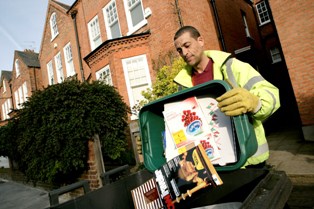
English councils achieved a provisional household recycling and composting rate of 46.2% in the first quarter of 2013/14, an increase of just 0.4% when compared to the same period 12 months earlier.
The local authority collected waste figures, which cover the period April to June 2013 were published by Defra today (January 6), showing that there is still much variation in rates between individual councils.
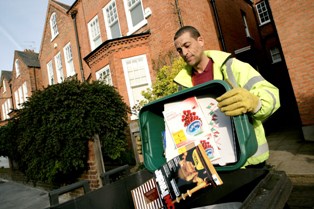
The marginal increase in recycling rates is likely to be of some concern to Defra, with progress still to be made to meet the 50% by 2020 EU recycling target. It comes at a time when the Department has said it will be stepping away from implementing any new policies on waste.
Data shows that household waste arisings remained relatively unchanged at 22.7 million tonnes in the 12 months to June 2013, whereas previously it had fallen steadily by 10% throughout 2008, 2009 and 2010.
Meanwhile, the quarterly household waste recycling rate reached 46.2% between April and June 2013 compared to 45.8% in the same quarter in 2012, representing the highest rate achieved for the period. Total household waste arisings were up from 6,031 to 6,119 tonnes on the same quarter in 2012.
The data does suggest that household dry recycling was 3% higher in April to June 2013 than 12 months earlier, while household waste for composting saw an increase of 1.7% in the same period.
But, the amount of local authority-managed waste going to landfill or incineration was also 1.3% higher in this quarter compared to the same period in 2012. But, the amount of waste sent to landfill fell 2.0% from 2,267 tonnes to 2,221 tonnes. Landfill accounted for 32% of all local authority waste disposal.
In comparison, incineration with EfW rose from 1,301 tonnes in the same period 12 months earlier to 1,395 tonnes in 2013 accounting for 20.4% of local authority waste disposed.

However, Defra notes that the waste recycling and composting volumes are seasonal, with increased amount of garden or organic waste captured between April and September each year. It also claims the rise in waste being sent for incineration or landfill in the last quarter was not a reliable comparison.
Commenting on the latest figures, a spokeswoman for Defra said: The UK has made tremendous progress over the last 10 years and we remain committed to meeting our target. We will continue to work with local authorities and industry to promote good practice and look at how recycling can be made easier.”
Changes
Defra is planning a number of changes to its local authority waste and recycling data. From May this year, the calculation of the household recycling rate will be brought into line with the definition of household waste under the revised waste framework directive.
Related Links
This means the calculation will exclude gulley emptying and street sweepings, as well as other waste not coming directly from households.
And, from August this year, Defra intend to show annual estimates for calendar years rather than financial years.
Key findings on the provisional statistics include:
The annual household waste recycling rate rose slightly to 43.3% in the 12 months to June 2013, having remained at just over 43% since March 2012. The quarterly household waste recycling rate, which is highly seasonal, reached 46.2% in England between April and June 2013, the highest rate achieved for an April to June period.
Household waste arisings remained relatively unchanged at 22.7 million tonnes in the 12 months to June 2013. Previously household waste arisings fell steadily by 10% throughout 2008, 2009 and 2010.
Local authority managed waste going to landfill or incineration was 1.3% higher in April to June 2013 compared to the same period in 2012 but is 32% lower than in the same period in 2006.

Register for free to comment