


Last week, the Local Authority Recycling Advisory Committee (LARAC) offered a stern response to a report issued by the Organics Recycling Group of the Renewable Energy Association (REA) which called for food waste collections to be made mandatory across England.
REA’s report claimed that the move would lead to a ‘cost benefit’ to councils, due to a reduction in disposal costs (see letsrecycle.com story).
However, LARAC chief executive Andrew Bird then described the report as “self-serving”, claiming that it did not reflect the actual savings that might be realised by the introduction of separate food waste collections by councils (see letsrecycle.com story).
Funding
LARAC also pointed out that action by the Welsh and Scottish Governments to encourage separate food waste collections had also been backed by investment in collection infrastructure – and claimed that opportunities are “more limited” in England.
Responding to Mr Bird’s comments, Jeremy Jacobs, technical director at the REA said: “We completely recognise that each local authority’s circumstances are different, and all face difficult budgetary situations. Local authorities have risen to the challenges set to them by the budget cuts to date, and have done an extraordinary job of protecting public services.
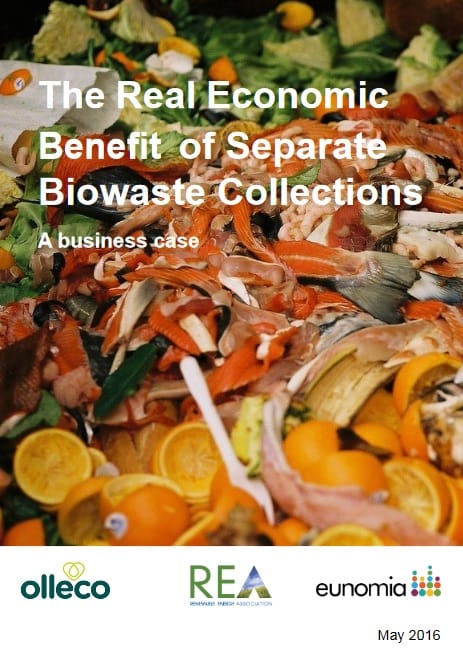
“The goal of our report was to independently model the costs associated with separate biowaste collections for businesses and local authorities, and to constructively add to the discussion about waste and recycling. To move forward with the shared aim of improving waste collections and increasing recycling in the most cost effective way, collaboration will be critical.”
Planning
Mr Jacobs added that further government support would help to increase the uptake of separate waste collections by local authorities, and added that such changes would have to be planned for “well in advance”.
He said: “That is why we are not campaigning for immediate change. Our ask is that separate collections to be introduced over a multi-year timeframe, to allow councils to introduce them at the most economically sensible time – perhaps when they upgrade their fleet or tender their service.
“Our core point was to highlight that direct and indirect savings are possible, and that cost need not be a barrier to introducing separate food waste collections. We would be delighted if our report served as a platform from which we can have a constructive conversation with local government and others about how we can work together to overcome barriers, reduce costs, improve sustainability, and meet our legally binding carbon budget and 2020 renewable energy and recycling targets.”

Register for free to comment