



The Environment Agency has published its provisional packaging data for the fourth quarter of 2013, which appears to show that targets have been met for all materials.
The provisional data on the National Packaging Waste Database shows that despite concerns that many obligated producers and schemes would have struggled to meet the 2013 targets for some materials, performance in the fourth quarter of the year was strong.

And, some compliance schemes claim that the positive performance in Q4 could lead to a more stable year for PRN prices in 2014, due to the amount of material carried over from 2013.
Glass saw a spike in the tonnages collected, with over 300,000 tonnes sent to re-melt applications, with 173,000 tonnes going to aggregate applications – a significantly higher tonnage than had been achieved in previous quarters. However the recycling of ‘other’ glass was not high enough for the material to meet its own obligation, with some schemes having to use more expensive re-melt PRNs to cover their obligations.
The spike in collection has been driven by a high PRN price for re-melt glass, which peaked at between 8090 per tonne in December having begun the year at around 50 per tonne.
Meanwhile, plastics continued its strong performance from quarter three, with over 191,000 tonnes collected throughout the last quarter of the year. This was despite fears early in the year that the sector would struggle to meet the 37% recycling target set by Defra following a sluggish first half.
PRN
Trading in plastics has been bolstered by a high PRN value, which was caused in part by the rising recycling target, as well as the restriction on the export of material to China the UKs largest overseas market for material, which began in early in the year. Plastics PRNs reached a high of around 70 per tonne in July, having begun the year valued at around 12-15 per tonne.
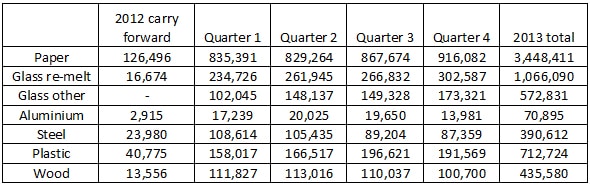
In paper, the volume sent for reprocessing or export remained above the required level needed to meet the overall recycling obligation for the year, with a total of 916,082 tonnes being recycled in Q4. This follows on from a similarly strong performance for the material throughout the year.
Meanwhile, reprocessing of steel and aluminium have remained at broadly similar levels when compared to the first half of the year, meaning that both materials have met their 2013 recycling targets.

‘More volatile PRN prices negatively affect producers that are focusing on achieving their budgets. The increased price of PRN prices during the year will have no doubt have affected many producers.’
James Piper, Budget Pack
James Piper commercial manager at compliance scheme Budget Pack, said that the figures were ‘positive’ for packaging producers obligated under the regulations.
He said: The provisional figures for Q4 paint a much needed positive picture; indicating that producers can expect more balanced costs this year.
More volatile PRN prices negatively affect producers that are focusing on achieving their budgets. The increased price of PRN prices during the year will have no doubt have affected many producers. Therefore, it is encouraging to see good carry-in figures with most materials, the exception being glass, which should benefit from a reduced target following the consultation in mid-March.
It would seem the increased value of glass and plastic PRNs is widely responsible for the dramatic increase in the reported reprocessed tonnage, in line with the principles of the PRN system.
Carry-over
Chris Taylor, PRN Trader at Clarity Environmental, added: Overall, the provisional data brings welcome news that recycling levels have grown for the first time since 2008, indicating that the PRN system is working to achieve what it aims to.
As predicted, Glass Other recycling was not strong enough to cover its own obligation, which meant that late buyers had to cover their Other obligation with the more expensive Remelt PRNs. The 15,000t that is carried over is surprising based on the perceived PRN deficits in the market in the last quarter.
Related Links
Whether real or simply perception, the higher PRN prices weve seen have enabled struggling grades to increase levels.
We expect to now see plastic prices softening this year, based on the large 48,000 tonne carry-over, which makes the 2014 target look achievable.

Register for free to comment