

However, collections may still not be occurring at the rate needed to meet government-set targets, which have been described as ‘challenging’ by a number of experts within the sector (see letsrecycle.com story).
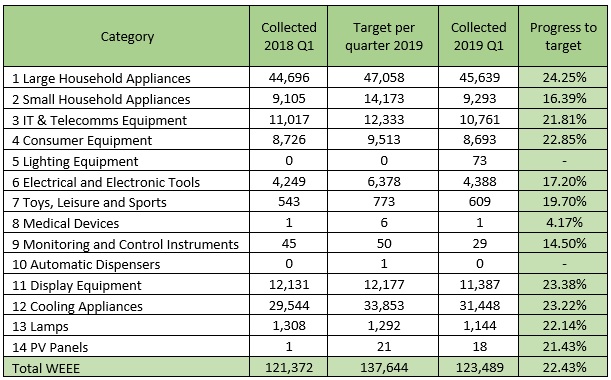
Data on the volume of household WEEE collected for recycling was published by the Department for Environment, Food and Rural Affairs (Defra) last week (1 June) covering the first quarter of 2019 (January to March).
Fee
Targets for the collection of WEEE have been missed in consecutive years, with more than £10 million having been taken in ‘compliance fee’ money from schemes who have been unable to meet their targets. It is intended that this money will finance projects aimed at boosting the collection of WEEE.
For 2019, Defra has confirmed an overall goal for WEEE compliance schemes to collect a total of 550,577 tonnes of WEEE for the year in March, an increase of roughly 12% than the total amount of household WEEE collected and reported by compliance schemes in 2018.
The first quarter data offers the first glimpse of how schemes are progressing towards targets and in comparison to previous years.
Trend
This week’s figures indicate that around 2,000 tonnes more material was collected in 2019 Q1 compared to the same three-month period in 2018. In particular an increase was seen in the large household appliances category, where collections were recorded at a higher level than at any point in 2018.
A similar increase has been recorded in the cooling appliances category, with collections having increased by 1,900 tonnes compared to the same period in 2018.
However, targets will likely be missed across all categories of WEEE unless the collection rate increases above the current level.
Commenting on the data, Vikkie Fitzgerald, WEEE compliance scheme manager at Clarity Environmental, said that it underscores concerns raised over the ability to meet targets in 2019.
She commented: “The Q1 data reinforces concerns over whether the UK can meet the higher collection targets this year. Whilst the first quarter has not been a historically reliable indication of annual performance, data from more recent years has shown that collections have failed to recover after this period, and it remains unlikely that the UK will meet its collection targets for 2019.
“Whilst the first quarter has not been a historically reliable indication of annual performance, data from more recent years has shown that collections have failed to recover after this period, and it remains unlikely that the UK will meet its collection targets for 2019.”
Vikkie Fitzgerald
Clarity Environmental

“There is the 2017 compliance fee funding to take into account, with significant discussion on how the revenues will be used to boost household collection rates, improve public perception of safe, confidential recycling, and improving education on how, what and why to recycle WEEE. But whether these projects can have a significant impact to support the UK in meeting the challenging 2019 obligations is widely questioned.
“Unsurprisingly, categories 2-10 stand out as the most underperforming collection categories. Category 13 lamps also shows significant under collection versus target at this stage.”
Producer compliance scheme Repic said that the figures underscore the need to understand where WEEE is arising.
Mark Burrows-Smith, the organisation’s chief executive, said: “It is encouraging to see that the tonnage of WEEE collected overall has held up relative to this time last year. As this is only one quarter’s data, it is too soon to identify a trend.
“As an industry, it is important that we continue to work together to understand what impacts on the amount of WEEE collected including how and where WEEE is flowing away from the producer compliance system. Obtaining better data is a key priority in reviewing EPR for WEEE in the UK
“We are pleased to be supporting the Anthesis WEEE Fund research project to provide better data on EEE and WEEE flows.”

Register for free to comment