


The prices being paid for recovered PET plastic bottles appear to have reached some of their highest ever levels due to a steady increase in domestic and overseas demand.

The prices are up to £200 per tonne higher than those paid for the material in November 2008 after the market crashed and even exceed the “inflated” prices of £240 per tonne seen the month before (see letsrecycle.com story).
The rise has been attributed to an increased push among British-based companies to create food-grade quality plastics, which requires PET bottle feedstock to meet food and drinks packaging standards, and also continued demand from the export market.
John Simmons, chief executive of plastics recycling trade body Recoup, told letsrecycle.com: “They are certainly the highest prices that have been around for some time. It is not a drop in the ocean and we think we are going to see three or more months at these levels.”
Impact

“I have never seen the prices this high for PET,” said one plastics purchasing manager. “I think the UK market is the one that is inflating prices”.
The latest figures represent a steady growth in the prices being paid for PET. In September 2009, the material was worth £160 to £180 per tonne, which has risen by as much as £10-per-tonne each month to reach the current levels of £230 to £260 per tonne.
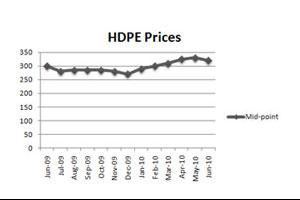
In context, the price being paid for HDPE plastic – such as milk bottles – has only risen by a total of £30 over the same period from £260 to £310 per tonne to £300 to £340 per tonne.
Demand
Companies currently generating food-grade plastic are AWS Eco Plastics and London-based Closed Loop Recycling, with plastic recycling firm Jayplas set to open a large-scale food grade production facility at Corby in the next couple of months.
And, Jane Bickerstaff, director at the Industry Council for Packaging and Environment (INCPEN), said it was “not a surprise” prices for recovered PET were currently so high as there had been increased calls for the material among her members.
She said: “Not only is there now high market demand but, speaking to reprocessors, we seem to be having real problems getting clean plastic bales and because there isn't the capacity to sort mixed plastic here we are having to send it to export – even if there are bottles in there.”
Europe
Stuart Foster, director at Recoup, claimed that price increase was not just confined to the UK but had been seen a rise across the European Union as a response to an increase in the amount of PET-recycling capacity being installed.
He said: “There has been significant PET reprocessing capacity increases within the UK and EU during the past few years.”
Mr Foster urged councils to collect more plastic bottles to feed this demand. He said “There is now a real challenge to collect enough plastic bottles and commercial plastic material of a suitable quality to feed this PET reprocessing capacity growth.”
And, Mr Foster said increased collections of mixed plastics by local authorities, which are traditionally sold to Far East markets due to their “competitive pricing”, could have a knock-on effect for PET prices as it will lessen the amount of PET available for reprocessors.
He said: “The PET bottles within this mix will not be available to UK and EU PET reprocessors unless they install the expensive sorting equipment needed to separate out the PET bottles. This scenario will increase competition for the PET material that is available and therefore may push values even higher in the longer term.”



Register for free to comment