


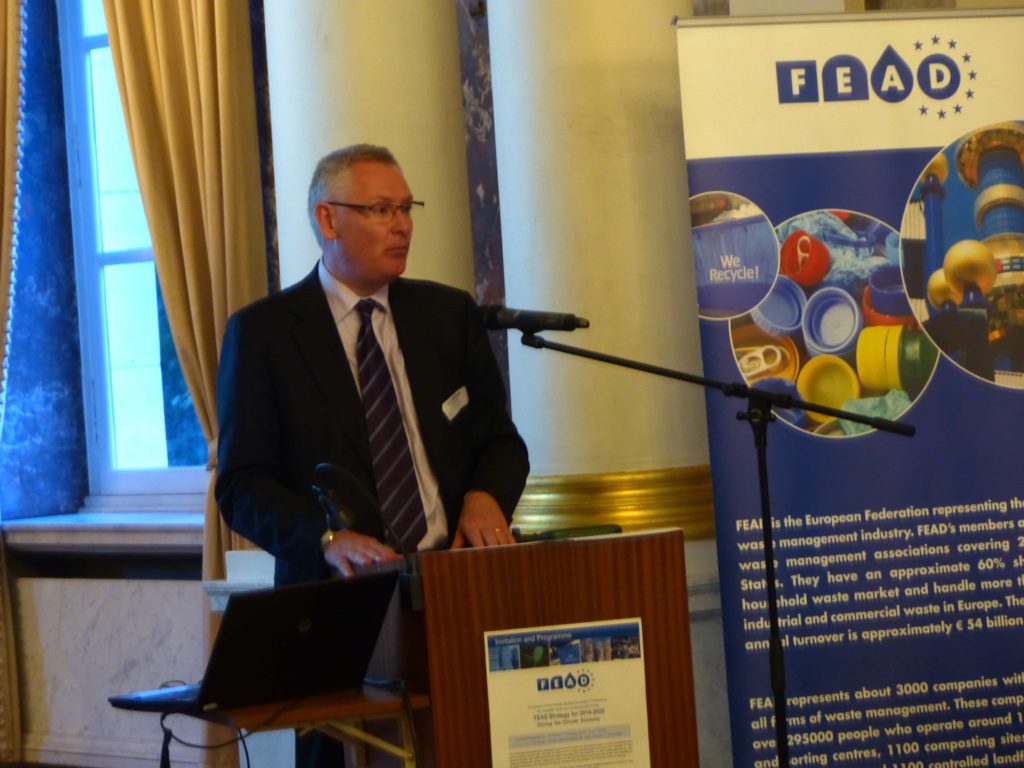
In his maiden speech as the president of FEAD – the federation for the waste management industry in Europe – Mr Palmer Jones said that to date European policy has focused on ‘end-of-pipe fixes’.
And, launching the organisation’s strategy for 2014-2020 in Brussels yesterday (October 7), Mr Palmer-Jones said that FEAD would pursue greater ‘coherence’ in policy making across the continent.
During his speech, the SITA chief executive touched on the proposals within the European Commission’s resource policy package, which was launched in July (see letsrecycle.com story).
Mr Palmer-Jones said that FEAD would seek to ensure that these are developed to be ‘as practical and effective’ as possible, should they be taken forward by the new European Commission and Parliament.
But, he added that policy makers had a ‘duty’ to assist sustainability and that they must accept that markets ‘can achieve a great deal, but not everything’.
He said: “European policy impacting on our sector has focused overwhelmingly on end-of-pipe fixes. While these clearly have a place in the policy toolbox, circularity means that we have to balance these so-called “push” policies with “pull” policies designed to build and sustain viable markets for secondary outputs.”
Instruments
Mr Palmer-Jones also said that the EU could consider ‘a range of instruments’ to encourage the use of recycled materials, including green taxes or lower VAT rates for recycled or reused goods.
He added: “Policy-makers must ensure that the balance of net cost between virgin and secondary raw materials incentivises the use of the ever-increasing recycling stream. This should be underpinned by a long-term European industrial strategy, which will help rebuild Europe’s reprocessing and manufacturing capacity, much of which is presently off-shored.”
[testimonial id = “46” align=”right”]
Within its strategy FEAD outlines a number of key areas that it will seek to encourage sustainable practises within Europe, including working with designers and manufacturers to ensure products are designed to be more easily reused or recycled, as well as calling for further reductions in landfill and incentives through producer responsibility schemes to encourage manufacturers to use recycled materials.
Mr Palmer-Jones was speaking after a short video address to FEAD members from the outgoing European Commissioner Janez Potocnik – the architect of the ‘Circular Economy’ policy package, which outlines a number of new targets for the waste and recycling sectors.
Commenting on the proposals, he said: “Our aim is to modernise, simplify and improve the consistency of EU waste legislation. The Circular Economy package proposes new realistic targets and includes measures to ensure better implementation. We paid particular attention to the feasibility of the targets: all proposed targets are already being met in the most advanced Member States or their regions.”


Register for free to comment