


Speaking to letsrecycle.com following a meeting of the Partnership’s joint committee on Monday (June 15), where councillors were warned that a potential £900,000 overspend for 2015/16 could arise, interim director Nigel Mattravers, said that a major budget shortfall could still be avoided.

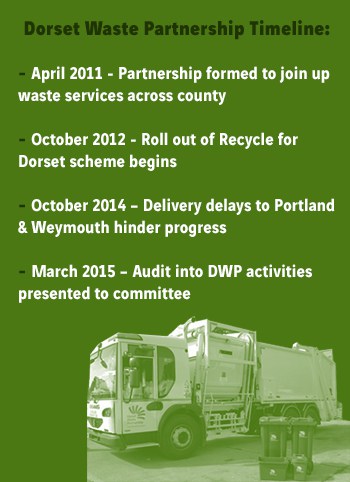
In March, the Partnership put in place a 37-point plan to address a £2.8 million overspend in its 2014/15 budget, caused by problems encountered during the rollout of the ‘Recycle for Dorset’ joint collection system (see letsrecycle.com story).
Actions included earlier warnings of any potential budget overspend, such as that highlighted at the meeting on Monday (June 15), as well as actions to cut worker absenteeism and reduce spending on vehicle hire.
Mr Mattravers took over as head of the Partnership, following the suspension of director Steve Burdis, who had overseen the rollout of the new service. Mr Burdis remains suspended from the role.
Speaking yesterday, Mr Mattravers told letsrecycle.com that the potential for an overspend on the 2015/16 budget had been highlighted to councillors as a precautionary measure and to increase transparency within the organisation.
Action plan
And, the interim director added that ‘around 80%’ of the action plan to improve the Partnership’s performance had now been completed, with work to optimise collection routes still to be carried out.
He said: “One of the positives is that the action plan had been agreed. That has already dealt with the management systems and ensuring that financial and budgetary monitoring were put in place whereas previously you didn’t know you had a problem until it happened.
“We are identifying the risk as there is better budget monitoring in place so we can provide the early warning rather than in previous years. We can give a heads up, but we can still avoid these problems.”
 Of the areas highlighted in the report was a fall in the value of recyclables, which it was predicted could result in an extra spend of up to £390,000 for the Partnership across the year.
Mr Mattravers has claimed that improvements in the recyclables – or recyclates – market since the report was put together are likely to have eased the financial cost to the Partnership.
“We would be lucky to avoid a shortfall altogether,” he noted. “One of the biggest risks is recyclate costs. Since the paper was written markets have actually improved, but recyclate prices are something that is hitting everybody and not just us. We have got a savings plan and within that there is £250k that we haven’t identified what we are going to do.”
Elsewhere Mr Mattravers highlighted the efforts to cut worker absenteeism, and reduce the need for spending on temporary agency staff, had made steady progress, with more rigorous procedures put in place to monitor long term absences.
Absenteeism was identified as among the key areas to reduce expenditure in the action plan, with a £300,000 saving identified by reducing absenteeism from 15 days to six days per year among waste operatives.


Register for free to comment