



The findings come after two large organics recycling companies Agrivert and Biffa Waste Services look to improve odour management at two of their sites, following complaints from local residents.
The Agencys report Biowaste sector performance shows that odour was the primary cause of permit breaches within the biowaste sector in 2011 and also led to a number of several serious pollution incidents.
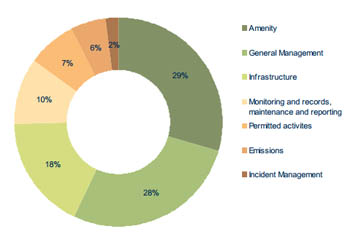
According to the Agency, there were 854 permit breaches across all biowaste sites in 2011. The breaches were caused by 149 of the 730 permitted biowaste sites in England and Wales. Amenity was the most common reason for the breaches, with 251 (29%) falling under this category. Of these, 209 were due to odour. Storage and handling were among other reasons for permit breaches.
Organics Recycling Conference 2013
The Environment Agency and Defra will be speaking about regulation at the forthcoming Organics Recycling Conference and Awards in Oxfordshire on March 21. To book your place visit the event website here.
Biowaste sites were also responsible for 38 serious pollution incidents in 2011 16% of the total from industries regulated by the Agency. 33 of these incidents affected local amenity, mainly due to odour. The greater number of serious incidents came from composting, although AD and land-spreading were also complicit with significant effect on local amenity mainly through bad odours. Biowaste sites were responsible for the highest number of serious pollution incidents per 100 permits in 2011 (see letsrecycle.com story).
Odour at biowaste sites was also a concern for the public. In 2011, 27 biowaste sites were of high public interest. Odour was the primary concern for 24 of these sites.
In a bid to help the biowaste sector keep odour under control, the Agency outlined key actions which would improve the situation. These included working with trade associations and external parties and improving guidance, advice and regulatory tools.
Performance
Commenting on the findings, the Renewable Energy Associations Organics Recycling Group (ORG) which represents organics recyclers – said the industry did not wish to continue with this level of performance.
Jeremy Jacobs, technical director of ORG said: Clearly this level of performance is not one that either the EA or industry wish to continue with. We need to be asking questions as to how realistic are the expectations of the regulator in respect to odour emissions. It is clear that the general public are much less tolerant then they were and that with increased pressure on space, finding suitable spaces to carry out biological treatment is becoming more challenging.
Biffa
The publication of the Environment Agency figures comes following two recent reports of odour at biowaste sites.
Waste management firm Biffa has been liaising with the Environment Agency over complaints about odour escaping from its anaerobic digestion facility in Cannock, Staffordshire. The Environment Agency served an enforcement notice in 2012 which required the waste management firm to find out what was causing the odour to escape.

Biffa has since said it has implemented a number of improvements to the facility, including: reducing the size of the air vents above the entry doors; improving the biofilter; installing an early warning system to predict odour escape; and installing a new treatment system for the air.
Giving an update on Friday (January 25), a Biffa spokeswoman said most of the improvements to the site were now complete. She added that Biffa will do everything within its power to address any complaints about odour.
She said: Biffa will meet all of its legal requirements which means if people have complaints they will look at them and do everything within its power to address them and do everything it can. A lot of the improvements to the facility have been made and we are doing more to try and improve it.
She added that Biffa will also being looking at the operations at its landfill, which is also located at the Cannock site.
Agrivert
Organics recycling firm Agrivert has also been subject to complaints from residents about the level of odour at its in-vessel composting (IVC) site in Ardley, Oxfordshire.
The Environment Agency said it received over 200 complaints in 2011 about odour which residents reported as coming from Agriverts site. Agency officers agreed that bad smelling waste should not be accepted at the site and the amount of waste treated on site should be reduced. Following this, the Agency said the number of odour complaints in the area fell dramatically in 2012.
When contacted by letsrecycle.com Agrivert said it was unable to comment on the issue for legal reasons.
A spokeswoman for the Agency said it was continuing to help the company improve its performance. She said: We understand that bad odours can really affect people’s quality of life and challenge all waste sites to be ‘good neighbours’ in their communities. Businesses needing guidance on tackling odour issues, or people with concerns about smells from waste sites and industrial plants, can always contact the Environment Agency via its 24-7 hotline on 0800 807060.



Register for free to comment