
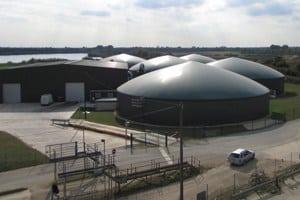
Published last week (August 9) by the Department for the Environment, Food and Rural Affairs (Defra), the 2012/13 annual report notes that 32 AD plants became operational in the year up to July 2013 and there are two facilities in England designed to inject gas to grid.

Proposals for a further 200 AD facilities have also secured planning permission, according to Defra.
However, the report notes the difficulty of securing funding for AD facilities from banks as the sector is still an immature industry, while it also states that ministers continue to be concerned about the possible effect on land of the use of crops as a feedstock for AD as the industry grows.
The Action Plan was first launched in 2011 in order to tackle barriers to the increased uptake of AD in England (see letsrecycle.com story).
Although there are no particular targets for increasing AD capacity in the Action Plan, it sets out 56 actions aiming to tackle barriers to the increased uptake of AD in England. Defra said it expects to complete the Action Plan later this year.
The eight major areas of work in the Action Plan were: Improving understanding of the AD baseline; building UK skills; building markets for digestate; raising awareness of AD; building markets for biomethane and transport fuels; AD in the rural community; finance; and, regulation.
Highlights of the past year noted in the report include the launch of a food waste internet portal to help developers identify potential feedstocks for AD; the publication of National Occupation Standards for those working in the AD industry; and the launch of the 15 million Rural Communities Energy Fund.
The report also touches on the progress made this year on developing markets for biomethane, with the development of a Quality Protocol for the use of biomethane in engines and a report published by the Low Emission Heavy Goods Vehicle Taskforce on increasing the uptake of the gas as a transport fuel.
Meanwhile, field trials currently being undertaken by Defra in partnership with the Waste & Resources Action Programme (WRAP) to demonstrate the benefits of using digestate in agriculture have reinforced the need for adequate digestate storage so that it can be applied at the right time.
The field trials are expected to be complete by March 2014, although one trial looking at further mitigating ammonia emissions from digestate application has been extended to 2015.
Finance
The report states that growth in the sector shows that there is money available for new AD capacity where a project can readily meet the requirements of potential funders.
However, the report describes AD as an immature industry with all the hallmarks of such, with most facilities in the UK having been in operation for less than three years.
As such, it notes that banks struggle to finance AD projects because the majority of new installations are built on equity investments, which continues to be the best option for initial funding of projects but are based on the promise of future performance.
But, the report states, the Green Investment Bank (GIB) published its first market report on AD in June 2013 (see letsrecycle.com story) and is investigating the opportunity to provide up to 50 million of debt financing, which is traditionally secured on the basis of past performance.
Highlights
- According to the annual report, the highlights of the past year include:
- The number of plants in the UK has risen to 110 up from 68 since the baseline was established as part of the AD Strategy in September 2011. More than 200 AD projects currently have received planning permission.
- There are two operational AD plants in England designed to inject into the gas grid.
Launch of a food waste portal helping developers to identify and quantify potential feedstocks for AD. - WRAP selected projects under the Driving Innovation in AD programme to take to demonstration phase and launched a second phase of the programme.
- Publication of National Occupational Standards for anaerobic digestion.
- Finalisation of a Quality Protocol on biomethane.
- DECC consulted on extending the Renewable Heat Incentive for the use of heat from biogas plants; pre-accreditation for feed in tariffs was introduced.
- Launch of the Rural Communities Energy Fund.
- Green Investment Bank support for anaerobic digestion including publication of a market report.
- Ecosystem Markets Task Force final report recognised the role for anaerobic digestion in closing the loop using farm waste to generate energy.
- Publication of ADBAs Practical Guide to AD, providing detailed information to developers and operators on existing standards and industry best practice.
- WRAP work to develop markets for digestate, with on-going field experiments in agriculture and new trials in the landscaping, regeneration, sports turf and horticulture sectors.
- Ten Demonstration Projects collecting food waste from businesses.
- Development and testing of new support tools aimed at businesses to help them procure and implement food collections into their organisations.

Register for free to comment