


On a visit to the county this week to find out more about the 850m PFI contract, Mr Bradshaw discussed the scope of the contract and visited a primary school, where he joined in papermaking with pupils.
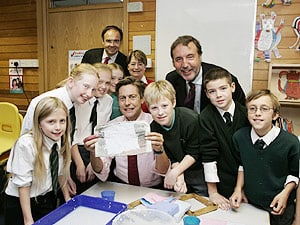 Ben Bradshaw making recycled paper with Woodborough Woods Primary School pupils, watched by (l-r) Cyrille du Peloux, Veolia Environmental Services’ chief executive for UK and Northern Europe, Councillor Stella Smedley, cabinet member for environment at Nottinghamshire CC, and local MP Paddy Tipping |
And, he highlighted the importance of modern recycling and waste management with regard to the Stern Report on climate change. Mr Bradshaw said: “It is important to talk about this in the scope of climate change. We have to get through to people that this part of our fight against catastrophic climate change.”
Explaining the contract, Simon Bussell, managing director of Veolia's Nottinghamshire operation, said that by 2020 the contract allows for the authority to become self-sufficient in handling its waste and be in a position to sell allowances under the Landfill Allowances Trading Scheme.
Split
The minister heard that the PFI contract had been split into two parts, known as contracts A and B.
Contract B, dubbed a major contract by Veolia because of the cost, is for the energy recovery facility. Contract A, the minor contract, covers everything else, including household waste and recycling sites, composting, dry recyclables and a transfer station infrastructure.
Cyrille du Peloux, chief executive of Veolia ES in the UK and northern Europe, told letsrecycle.com that there were several advantages to having the two contracts. “This means that the plant is ringfenced in terms of costs and revenues which will help facilitate the financing,” he said.
This would make it easier, said Mr du Peloux, to introduce external financing for the energy from waste plant. “This was our idea and we are now discussing with private equity sources in order to finance the plant, so it is better to have it this way.”
Partner
However, Mr du Peloux said that while the “dual contract allows flexibility about the reality of financing, we still have not chosen whether or not to have a partner.”
The other advantage the approach offers concerns any problems arising. The chief executive said: “The other change is linked with what happens if things go wrong for the local authority – if the operator doesn't deliver the service, on either the minor or major contract, and separately allows them to end the minor or major contract respectively.”
| Related links: |
However, Mr du Peloux suggested that other local authorities and contractors may not need to adopt this approach in the future because of recent changes in accounting practice, which make it possible to treat large assets, such as energy-from-waste plants, as off balance sheet items.
He explained: “In the future two contracts may not be needed. You can now isolate assets if they are specific assets, such as having a gate fee of their own if this isolates them from a balance sheet standpoint.”

Register for free to comment