



Rowers from Cambridge University have taken time out from the build up to the upcoming Boat Race to help promote plastics recycling.
 Cambridge rowers (pictured in white) celebrate beating city fire fighters (pictured in red) in the plastic bottle recycling competition |
The university team took part in a competition in which they beat Cambridge fire fighters and local radio station Star FM to be crowned Cambridgeshire bottle squashing champions.
The competition was run by Cambridgeshire county council to urge Cambridgeshire residents to improve the recycling of plastic bottles by removing the tops and squashing them. It also raised 2,000 for the Sir Steve Redgrave Charitable Trust and 500 each for the National Fire Service Benevolent Fund and the East Anglia's Children's Hospice.
Cambridge University boat club chief Robin Williams said: “It was real fun to squash plastic bottles and also give a hand to the councils to promote the important message of recycling plastics. We have taken in training for the 151st University Boat Race on March 27 and this was a good little bit of exercise.”
Since last July, plastic bottle recycling banks have been installed in supermarkets in Cambridge City, East and South Cambridgeshire. The council has said that this has helped to collect 60 tonnes of plastic, but if residents remove the bottle tops these banks could collect even more.
Radnorshire council begins kerbside recyclable collection
Residents in Radnorshire, Powys, will receive a free weekly collection of recyclable materials from March 23.
Over 34,000 households in the county are now offered kerbside collections, with households in Nantmel, Nantglas, Gwystre, Gravel Road, Llwyn Lane, Gaufron, Elan Village, St Harmon, Pantydwr and Tylwch set to join the scheme.
Householders are given bags specifically for paper, textiles, plastic packaging and cans. The bags will be collected on a weekly basis on the same day as normal refuse collection.
Powys county councillor Joy Shearer, board member with responsibility for waste management, said: “The success of the scheme depends on the individual householder dividing and separating their waste for recycling. The more we recycle, the less waste we transfer to landfill sites which means less damage is done to the environment.
| Related links: |
The leading council for recycling in Wales, Powys currently recycles or composts 27.97% of its municipal waste. The county has been set a target to reach a 40% recycling rate by 2009/10.
Kerrier best cork recyclers in Cornwall
Kerrier district council has beaten Cornwall county council in its own cork recycling competition.
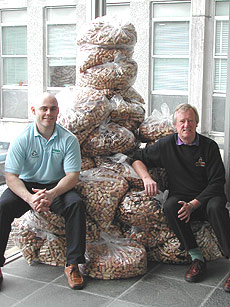 Paul Daddow (left) from Kerrier district council with Richard Bower of Cornwall county council with 50,000 corks collected for recycling |
This year marks the third annual Corks Recycling competition at the county council, and is also the first time that another council, Kerrier, has been involved.
Despite Cornwall's efforts increasing collections from 13,910 to 23,865 corks, Kerrier managed to retrieve 24,307 to surpass the county council's own impressive record.
The corks will be presented to Cornwall Scrapstores, where they will be distributed to over 800 member organisations, including schools, colleges, playgroups and art and crafts groups.
Richard Bower, spokesperson for Cornwall county council said: “With Kerrier district council just pipping us at the post, we will need to start collecting now for next year and I have a feeling that other councils may want to join in.”
Carlsberg fined for illegal hazardous waste disposal
Failure to sufficiently train staff in new special waste regulations has led to a 25,000 fine for brewer Carlsberg UK.
The company has also ordered to pay 2,001 costs by Selby magistrates after staff disposed of hazardous substances illegally. The company had admitted to two offences of knowingly depositing corrosive acid and alkali at Wormersley Mill, Whitley, without a proper waste management licence in July and September 2003.
It also admitted two charges of failing to complete a consignment note detailing the movement of the special waste from its brewery in Leeds to the Whitley site. The case was brought by the Environment Agency.
Agency officers visited a plastics recycling company in Whitley and found around 650 Carlsberg drums. Following tests it was discovered that the drums contained strong alikilis and acids. The agency said: “Both these substances are corrosive and classed as 'special waste.'”
In its defence Carlsberg UK told the court that staff at all levels had now been trained in the correct procedures of waste disposal to ensure that a similar incident never happened again.


Register for free to comment